Charles Haddon Spurgeon entered everlasting rest on January 31, 1892. While it may be true that Christendom lost one of her best preachers, it must not be forgotten that a local church, the Metropolitan Tabernacle, lost her faithful lead undershepherd. Though in mourning, the church sought to press on in obedience to the Lord in its worship and work. The following statement from the Elders and Deacons to the members of the Tabernacle demonstrates that Spurgeon was not a mere preacher; he was the pastor of his people. Though he had made some practical provisions for his passing, there was still much about the future that was uncertain. More importantly, however, Spurgeon had prepared the church spiritually, leading them to love and trust God and to live obediently to His glory, even amid loss.
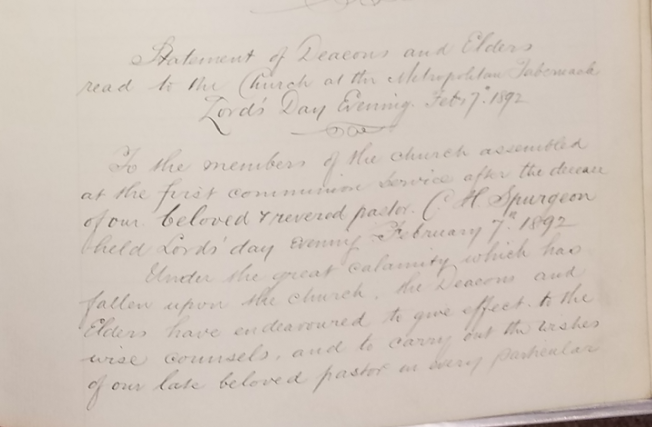
Statement of Deacons and Elders read to the Church of the Metropolitan Tabernacle, Lord’s Day Evening, Feb. 7, 1892.
To the members of the church assembled at the first communion service after the decease of our beloved and revered pastor, C.H. Spurgeon, held Lord’s Day evening February 7, 1892.
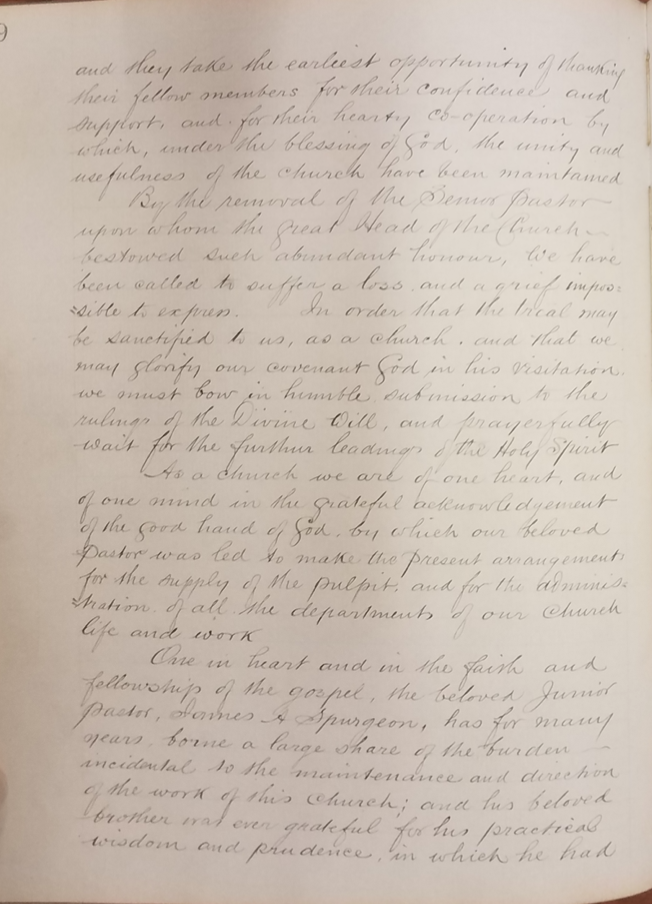
Under the great calamity which has fallen upon the church, the Deacons and Elders have endeavoured to effect to the wise counsels, and to carry out the wishes of our late beloved pastor in every particular, and they take the earliest opportunity of thanking their fellow members for their confidence and support, and for their hearty co-operation by which, under the blessing of God, the unity and usefulness of the church have been maintained.
By the removal of the Senior Pastor upon whom the Great Head of the Church bestowed such abundant honour, we have been called to suffer a loss and a grief so impossible to express. In order that the trial may be sanctified to us, as a church, and that we may glorify our covenant God in his visitation, we must bow in humble submission to the rulings of the Divine Will, and prayerfully wait for the further leading of the Holy Spirit.
As a church we are of one heart, and of one mind in the grateful acknowledgement of the good hand of God, by which our beloved pastor was led to make the present arrangement for the supply of the pulpit, and for the administration of all the departments of our church life and work.
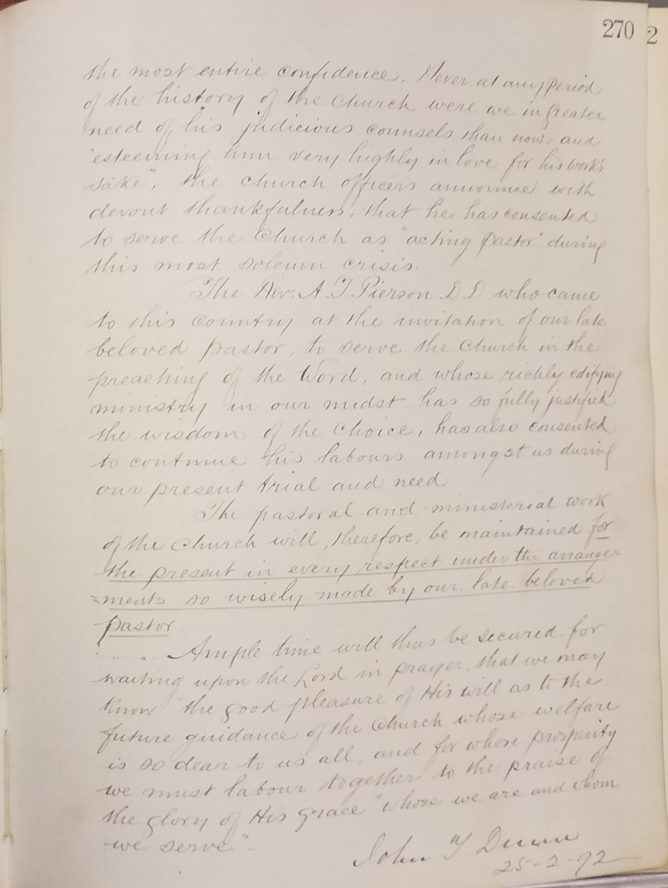
One in heart and in the faith and fellowship of the gospel, the beloved Junior Pastor, James A. Spurgeon, has for many years, borne a large share of the burden incidental to the maintenance and direction of the work of this church; and his beloved brother was ever grateful for his practical wisdom and prudence, in which he had the most entire confidence. Never at any period of the history of the church were we in greater need of his judicious counsels than now, and, “esteeming him very highly in love for his work’s sake,” the church officers announce with devout thankfulness, that he has consented to serve the church as “acting pastor” during this most solemn crisis.
The Rev. A. T. Pierson, D.D. who came to this country at the invitation of our late beloved pastor, to serve the church in the preaching of the Word, and whose richly edifying ministry in our midst has so fully justified the wisdom of the choice, has also consented to continue his labours amongst us during our present trial and need.
The pastoral and ministerial work of the church will, therefore, be maintained for the present in every respect under the arrangements so wisely made by our late beloved pastor.
Ample time will thus be secured for waiting upon the Lord in prayer that we may know the good pleasure of His will as to the future guidance of the church whose welfare is so dear to us all, and for whose prosperity we must labour together to the praise of the glory of his grace, “whose we are and whom we serve.”
The final weeks of Spurgeon’s life were spent in sunny Menton, in southern France. Throughout his ministry, he had gone there to recover from his various ailments and overwork. Now, in the fall of 1891, Spurgeon was there once again. Under the care of his wife Susie and skilled doctors, the congregation fully expected him to recover and return to London to continue his famous ministry at the Metropolitan Tabernacle. Spurgeon himself held on to this hope. But this was not to be. On January 31, 1892, Spurgeon went to be with the Lord.[1]
Throughout his ministry, Spurgeon wrote many letters to his congregation during his travels. Even when traveling abroad, visiting new places, and preaching before thousands, Spurgeon never forgot his own church. In his letters to them, we see the affection of a pastor for his people, his confidence in his elders and deacons, and his dependence on his people for their prayers. During his final trip to Mentone, Spurgeon committed to writing a weekly letter back to his people, updating them on his situation and encouraging them to persevere. These four letters comprise Spurgeon’s final pastoral words to his people.[2]
Over the next four weeks, we will be publishing Spurgeon’s last letters to his congregation, beginning on December 24 and ending on January 14. While nobody expected these to be his last words to his church, they are a fitting conclusion to his pastoral ministry. In them, we see Spurgeon’s confidence in God’s power to build up the church and save the lost, even apart from his own ministry. We see his call for his people to persevere in the truth of the gospel. And we see his evident love for them. In other words, what characterized Spurgeon’s ministry from the very first day continued to his last breath. May the same be true of pastors today.
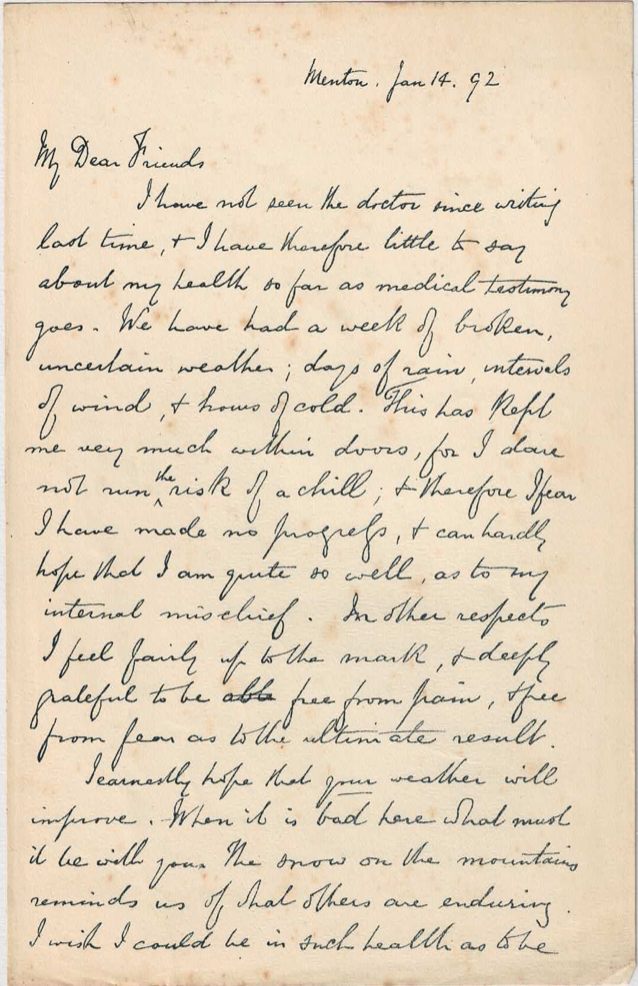
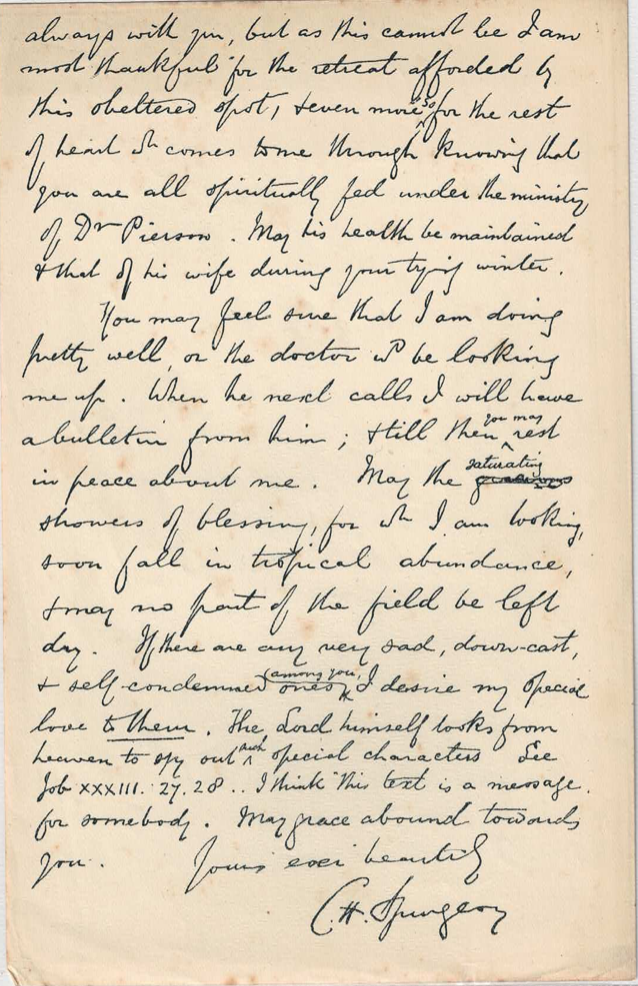
Menton. Jan. 14. 1892
My Dear Friends,
I have not seen the doctor since writing last time, & I have therefore little to say about my health so far as medical testimony goes. We have had a week of broken, uncertain weather; days of rain, intervals of wind, & hours of cold. This has kept me very much within doors, for I dare not run the risk of a chill; & therefore I fear I have made no progress, & can hardly hope that I am quite so well, as to my internal mischief. In other respects I feel fairly up to the mark, & deeply grateful to be free from pain, & free from fear as to the ultimate result.
I earnestly hope that your weather will improve. When it is bad here what must it be with you. The snow on the mountains reminds us of what others are enduring. I wish I could be in such health as to be always with you, but as this cannot be I am most thankful for the retreat afforded by this sheltered spot, & even more so for the rest of heart which comes to me through knowing that you are all spiritually fed under the ministry of Dr. Pierson. May his health be maintained & that of his wife during your trying winter.
You may feel sure that I am doing pretty well, or the doctor would be looking me up. When he next calls I will have a bulletin from him; & till then you may rest in peace about me. May the saturating showers of blessing, for which I am looking, soon fall in tropical abundance, & may no part of the field be left dry. If there are any very sad, down-cast, & self-condemned ones among you, I desire my special love to them. The Lord himself looks from heaven to spy out such special characters. See Job 33:27, 28. I think this text is a message for somebody. May grace abound towards you.
The final weeks of Spurgeon’s life were spent in sunny Menton, in southern France. Throughout his ministry, he had gone there to recover from his various ailments and overwork. Now, in the fall of 1891, Spurgeon was there once again. Under the care of his wife Susie and skilled doctors, the congregation fully expected him to recover and return to London to continue his famous ministry at the Metropolitan Tabernacle. Spurgeon himself held on to this hope. But this was not to be. On January 31, 1892, Spurgeon went to be with the Lord.[1]
Throughout his ministry, Spurgeon wrote many letters to his congregation during his travels. Even when traveling abroad, visiting new places, and preaching before thousands, Spurgeon never forgot his own church. In his letters to them, we see the affection of a pastor for his people, his confidence in his elders and deacons, and his dependence on his people for their prayers. During his final trip to Mentone, Spurgeon committed to writing a weekly letter back to his people, updating them on his situation and encouraging them to persevere. These four letters comprise Spurgeon’s final pastoral words to his people.[2]
Over the next four weeks, we will be publishing Spurgeon’s last letters to his congregation, beginning on December 24 and ending on January 14. While nobody expected these to be his last words to his church, they are a fitting conclusion to his pastoral ministry. In them, we see Spurgeon’s confidence in God’s power to build up the church and save the lost, even apart from his own ministry. We see his call for his people to persevere in the truth of the gospel. And we see his evident love for them. In other words, what characterized Spurgeon’s ministry from the very first day continued to his last breath. May the same be true of pastors today.
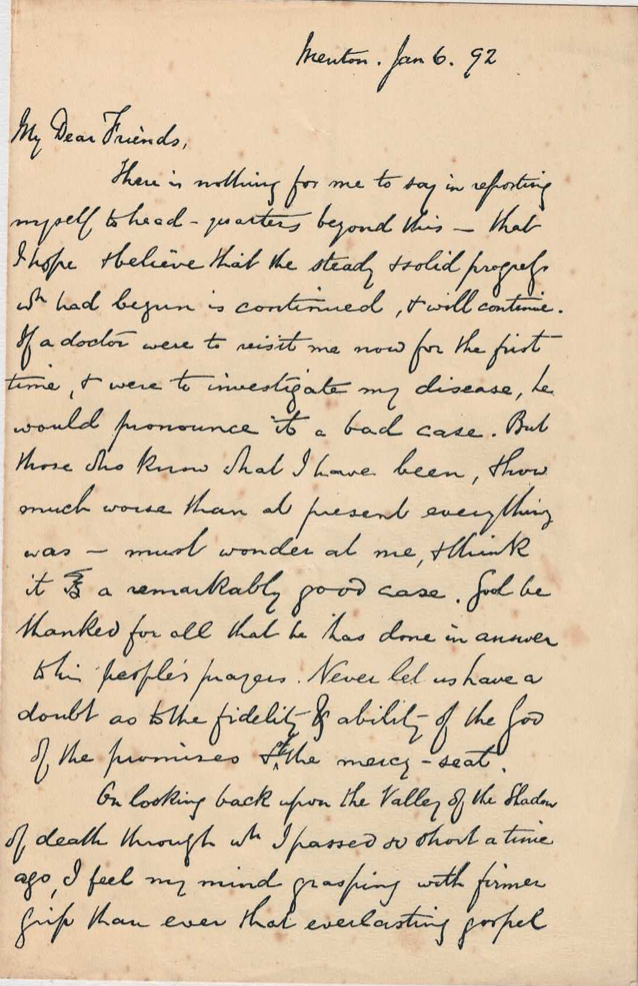
Menton. Jan. 6. 92
My Dear Friends,
There is nothing for me to say in reporting myself to head-quarters beyond this – that I hope & believe that the steady & solid progress which had begun is continued, & will continue. If a doctor were to visit me now for the first time, & were to investigate my disease, he would pronounce it to be a bad case. But those who know what I have been, & how much worse than at present everything was – must wonder at me, & think it a remarkably good case. God be thanked for all that he has done in answer to his people’s prayers. Never let us have a doubts as to the fidelity of ability of the God of the promises & of the mercy-seat.
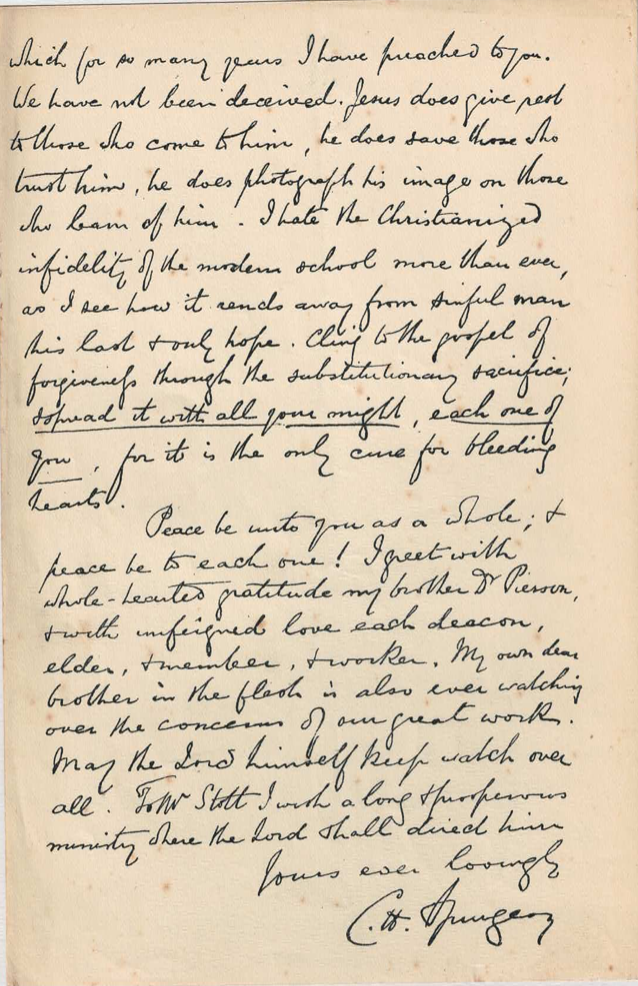
On looking back upon the Valley of the Shadow of death through which I passed so short a time ago, I feel my mind grasping with firmer grip than ever that everlasting gospel which for so many years I have preached to you. We have not been deceived. Jesus does give rest to those who come to him, he does save those who trust him, he does photograph his image on those who learn of him. I hate the Christianized infidelity of the modern school more than ever, as I see how it rends away from sinful man his last & only hope. Cling to the gospel of forgiveness through the substitutionary sacrifice; & spread it with all your might, each one of you, for it is the only cure for bleeding hearts.
Peace be unto you as a whole; & peace be to each one! I greet with whole-hearted gratitude my brother Dr. Pierson, & with unfeigned love each deacon, elder, & member, & worker. My own dear brother in the flesh is also ever watching over the concern of our great work. May the Lord himself keep watch over all. To Mr. Stott, I wish a long & prosperous ministry where the Lord shall direct him.
The final weeks of Spurgeon’s life were spent in sunny Menton, in southern France. Throughout his ministry, he had gone there to recover from his various ailments and overwork. Now, in the fall of 1891, Spurgeon was there once again. Under the care of his wife Susie and skilled doctors, the congregation fully expected him to recover and return to London to continue his famous ministry at the Metropolitan Tabernacle. Spurgeon himself held on to this hope. But this was not to be. On January 31, 1892, Spurgeon went to be with the Lord.[1]
Throughout his ministry, Spurgeon wrote many letters to his congregation during his travels. Even when traveling abroad, visiting new places, and preaching before thousands, Spurgeon never forgot his own church. In his letters to them, we see the affection of a pastor for his people, his confidence in his elders and deacons, and his dependence on his people for their prayers. During his final trip to Mentone, Spurgeon committed to writing a weekly letter back to his people, updating them on his situation and encouraging them to persevere. These letters comprise Spurgeon’s final pastoral words to his people.[2]
Over the next four weeks, we will be publishing Spurgeon’s last letters to his congregation, beginning on December 24 and ending on January 14. While nobody expected these to be his last words to his church, they are a fitting conclusion to his pastoral ministry. In them, we see Spurgeon’s confidence in God’s power to build up the church and save the lost, even apart from his own ministry. We see his call for his people to persevere in the truth of the gospel. And we see his evident love for them. In other words, what characterized Spurgeon’s ministry from the very first day continued to his last breath. May the same be true of pastors today.
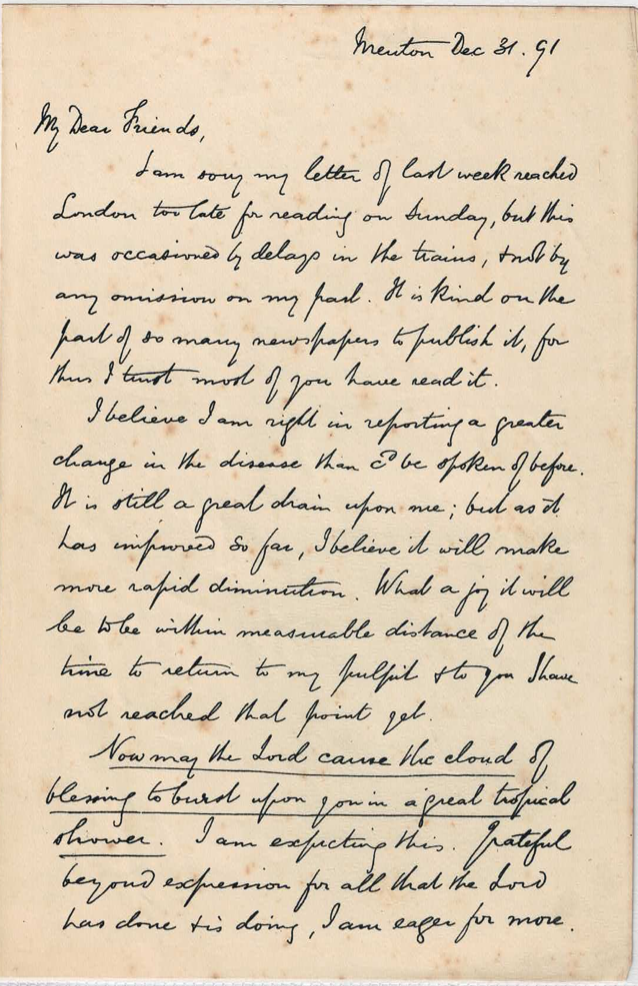
Menton Dec. 31. 91
My Dear Friends,
I am sorry my letter of last week reached London too late for reading on Sunday, but this was occasioned by delays in the trains, & not by any omission on my part. It is kind on the part of so many newspapers to publish it, for thus I trust most of you have read it.
I believe I am right in reporting a greater change in the disease than could be spoken of before. It is still a great drain upon me; but as it has improved so far, I believe it will make more rapid diminution. What a joy it will be to be within measurable distance of the time to return to my pulpit & to you. I have not reached that point yet.
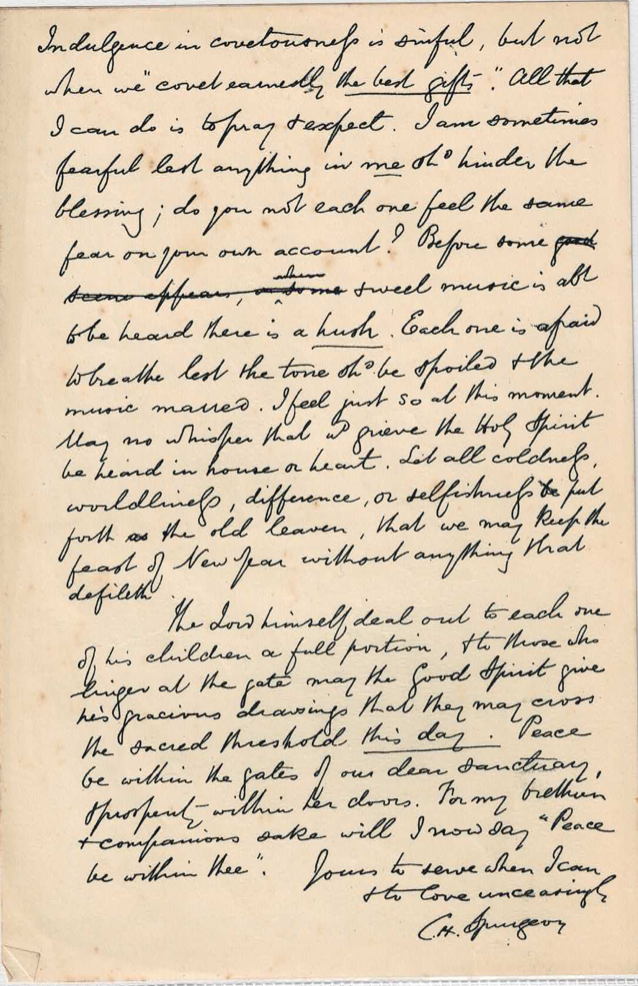
Now may the Lord cause the cloud of blessing to burst upon you in a great tropical shower. I am expecting this. Grateful beyond expression for all that the Lord has done & is doing, I am eager for more. Indulgence in covetousness is sinful, but not when we “covet earnestly the best gifts.” All that I can do is to pray & expect. I am sometimes fearful lest anything in me should hinder the blessing; do you not each one feel the same fear on your own account? Before some sweet music is about to be heard, there is a hush. Each one is afraid to breathe lest the tone should be spoiled & the music marred. I fell just so at this moment. May no whisper that would grieve the Holy Spirit be heard in house or heart. Let all coldness, worldliness, difference, or selfishness be put forth as the old leaven, that we may keep the feast of New Year without anything that defileth.
The Lord himself deal out to each one of his children a full portion, & to those who linger at the gate, may the Good Spirit give his gracious drawings that they may cross the sacred threshold this day. Peace be within the gates of our dear sanctuary, & prosperity within her doors. For my brethren & companions sake will I now say, “Peace be within thee.”
The final weeks of Spurgeon’s life were spent in sunny Menton, in southern France. Throughout his ministry, he had gone there to recover from his various ailments and overwork. Now, in the fall of 1891, Spurgeon was there once again. Under the care of his wife Susie and skilled doctors, the congregation fully expected him to recover and return to London to continue his famous ministry at the Metropolitan Tabernacle. Spurgeon himself held on to this hope. But this was not to be. On January 31, 1892, Spurgeon went to be with the Lord.[1]
Throughout his ministry, Spurgeon wrote many letters to his congregation during his travels. Even when traveling abroad, visiting new places, and preaching before thousands, Spurgeon never forgot his own church. In his letters to them, we see the affection of a pastor for his people, his confidence in his elders and deacons, and his dependence on his people for their prayers. During his final trip to Mentone, Spurgeon committed to writing a weekly letter back to his people, updating them on his situation and encouraging them to persevere. These letters comprise Spurgeon’s final pastoral words to his people.[2]
Over the next four weeks, we will be publishing Spurgeon’s last letters to his congregation, beginning on December 24 and ending on January 14. While nobody expected these to be his last words to his church, they are a fitting conclusion to his pastoral ministry. In them, we see Spurgeon’s confidence in God’s sovereign grace, even apart from his own ministry. We see Spurgeon’s call for his people to persevere in the truth of the gospel. And we see his evident love for them. In other words, what characterized Spurgeon’s ministry from the very first day continued to his last breath. May the same be true of pastors today.
Menton. Dec. 24. 91.
My Dear Friends,
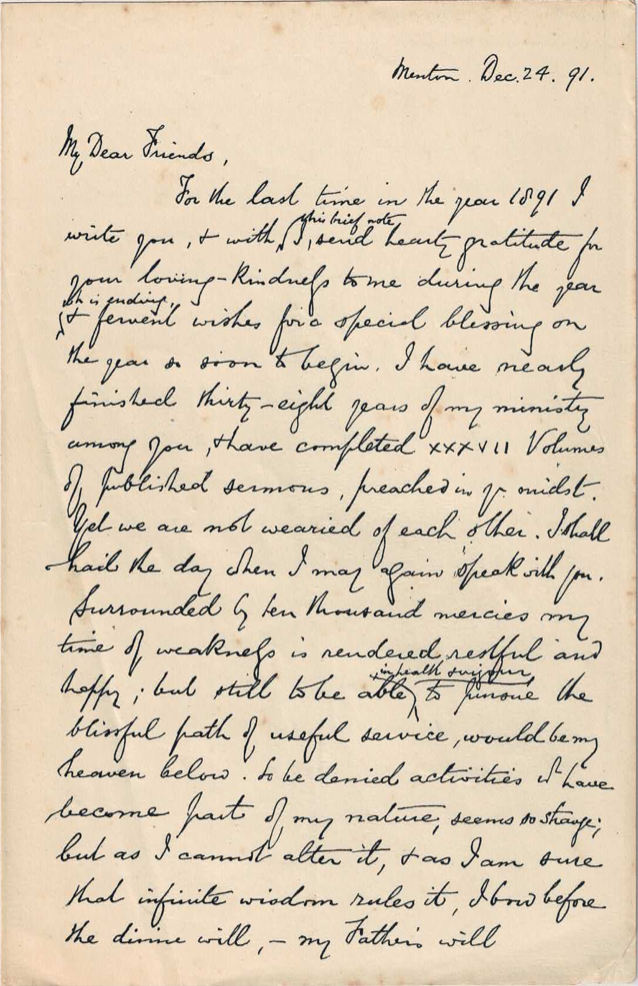
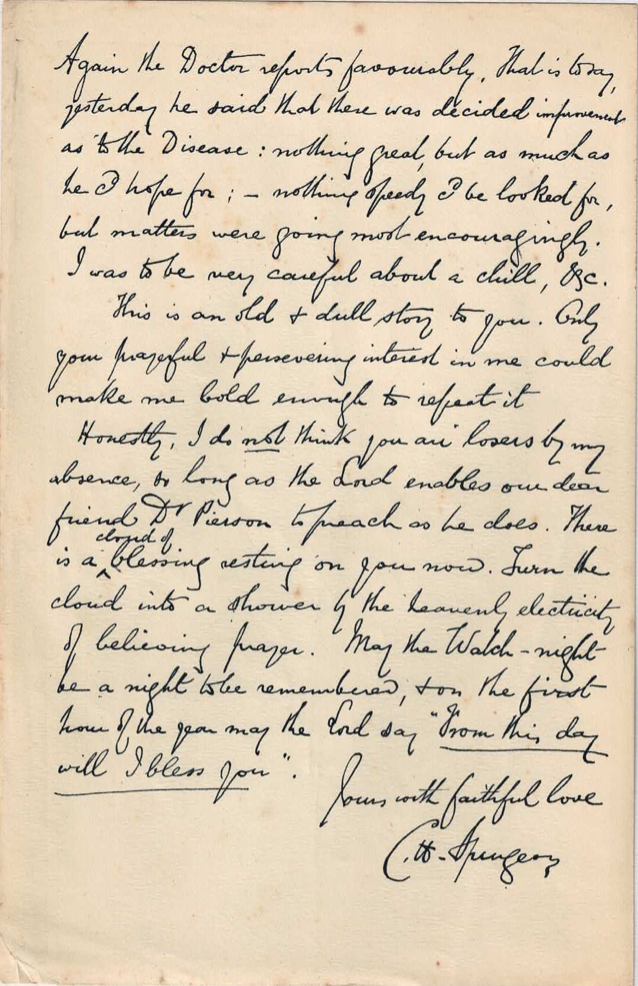
For the last time in the year 1891 I write you, & with this brief note, I send hearty gratitude for your loving-kindness to me during the year which is ending & fervent wishes for a special blessing on the year so soon to begin. I have nearly finished thirty-eight years of my ministry among you, & have completed XXXVII volumes of published sermons, preached in your midst. Yet we are not wearied of each other. I shall hail the day when I may again speak with you. Surrounded by ten thousand mercies my time of weakness is rendered restful and happy; but still to be able in health & vigour to pursue the blissful path of useful service, would be my heaven below. To be denied activities which have become part of my nature, seems so strange; but as I cannot alter it, & as I am sure that infinite wisdom rules it, I bow before the divine will, — my Father’s will. Again the Doctor reports favourably, that is to say, yesterday he said that there was decided improvement as to the disease; nothing great, but as much as he could hope for; — nothing speedy could be looked for, but matters were going most encouragingly. I was to be very careful about a chill, etc.
This is an old & dull story to you. Only your prayerful & persevering interest in me could make me bold enough to repeat it.
Honestly, I do not think you are losers by my absence, so long as the Lord enables our dear friend Dr. Pierson to preach as he does. There is a cloud of blessing resting on you now. Turn the cloud into a shower by the heavenly electricity of believing prayer. May the Watch-night be a night to be remembered, & on the first hour of the year may the Lord say, “From this day will I bless you.”
Almost a decade after Spurgeon’s death, his publishers (and Tabernacle members) Passmore and Alabaster brought out a book of 367 pages. It was filled with 40 addresses by Spurgeon, almost all of which were given extemporaneously at his church’s Monday evening prayer meeting. When I came to our congregation (originally named Metropolitan Baptist Church, presumably after Spurgeon’s congregation), I soon rearranged our prayer meeting. One of my most enjoyable reading experiences was earlier this year when I first read Mr. Spurgeon’s book Only a Prayer Meeting! I had bought my copy of the 1976 Pilgrim Publications reprint in 1984 in Inverness, Scotland. But it had lain unread among scores of other volumes of Spurgeon’s works, which, for some reason, got more of my attention.
Then I took it with me on a trip and began to read it on the plane flight across the country from San Diego to DC. It captured my attention. I couldn’t put it down. I found Spurgeon describing his own prayer meeting in terms at many points like our own! And I also read accounts of remarkable providences and Biblical wisdom as Spurgeon exhorted his own people to prayer. And regularly, more than a thousand of them would join him on a Monday evening for their prayer meeting.
Pastors, you will enjoy the outspokenness of Spurgeon in his opinions, even if you may not always share his view. In his first lecture, he is decrying the spectacle of street work of The Salvation Army, accompanied by too many passing false conversions. Spurgeon says, ‘Gold, silver and precious stones are scarce material, not easily found; but then they endure the fire. What is the use of religion which comes up in a night, and perishes as soon?’
Other times, you’ll find yourself chuckling in recognition or agreement. Practical wisdom is found on every page. ‘Let as many as possible take part in the utterance of the church’s desires; the change of voice will prevent weariness, and the variety of subjects will excite attention. Better to have six pleading earnestly, than two drowsily. . . .’ We’ve all been there!
Another part of the wonder of this volume is the plain way with which Spurgeon writes even more as a Christian than as a pastor. What I mean is that his wisdom in being a pastor is merely a subset of his greater and deeper experience as a Christian. In one lecture Spurgeon warns ‘There is even a danger of loving some things which are associated with Christ as much as we love Christ Himself; and we must be on the watch against such a feeling as that.’ That simple observation is what a living Christian feels who loves the ministry God has called him to, but who loves God more, and who (rightly) senses the danger in his own soul of loving the Lord’s work more than the Lord Himself. May God deliver each one of us from such wrong-headed and wrong-hearted professionalism.
His evangelistic arguments with the reluctant believer are powerful, too. Look at the last couple of paragraphs in his address ‘God’s Willingness to Bless Saints and Sinners.’ In the middle of that passage, Spurgeon urges the wavering on to faith—‘Make a dash for it. Believe that Jesus Christ is able to save you. Trust Him, and He has saved you. . . . Cease to look within, and begin to look up.’ Here Spurgeon’s evangelistic heart pours out through his exhortations to pray. He is a challenge to us, and a model for us.
Along the way, Spurgeon attacks worldliness and annihilationism. He attacks giving up too soon. ‘We are called, not to flirt with error, but to fight with it; therefore, let us be brave, and push on the conflict.’ And he teaches the Bible, too. When was the first public worship service in the world? Spurgeon has a whole address on it here! Can children be converted? Yes, he answers! Fistfuls of simple truths are here given out for the reader who will take a few minutes and peruse a chapter. One or two a day, and the whole volume will be read in less than a month. Once I started reading it on that flight I couldn’t put it down until I had read the whole thing!
There is a sad note in this book. Spurgeon could tell that the pouring out of the Spirit he had so long enjoyed was waning toward the end of the 19th century. He writes ‘Thirty years ago, things were very different from what they are now. It was easy to gather a congregation then, compared with what it is now; the spirit of hearing is departing from our cities.’ As we face our own questions of spiritual decline, let’s listen to this wise older brother who has gone before us, about how we can assault the throne of grace ourselves, and lead our congregations to join us in this holy contest.
This article was originally published on the Christian Focus blog here.
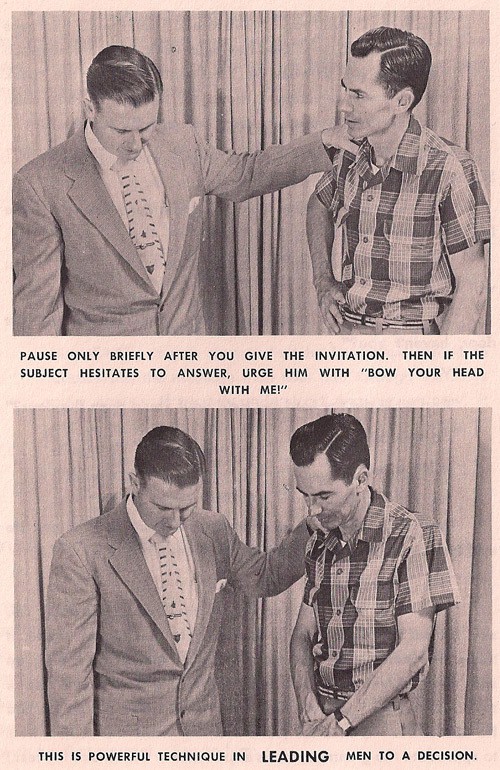
In 1959, C. S. Lovett, pastor of Baldwin Park Baptist Church, published his guide to personal evangelism, entitled Soul-Winning Made Easy. In it, he describes “the controlled conversation technique,” which “ignores excuses and complete side-steps the explosive area of religious debate.” Instead, Lovett focuses on Revelation 3: Jesus knocking on the door of our hearts and urging sinners to open their hearts to him. Lovett writes, “If he can truly be made aware of Christ waiting at the door of his heart, his responsibility becomes most clear. This makes soul-winning a positive ministry requiring fewer skills. Actually, it is a new frontier which allows Christian obedience to become fun!”
In addition to a gospel presentation, Lovett provides practical directions in evangelism (complete with illustrations). For example, in pressing for a decision, Lovett instructs,
Lay your hand firmly on the subject’s shoulder (or arm) and with a semi-commanding tone of voice, say to him, “Bow your head with me.”
NOTE: Do not look at him when you say this, but bow your head first. Out of the corner of your eye you will see him hesitate at first. Then, as his resistance crumbles, his head will come down. Your hand on his shoulder will fell the relaxation and you will know when his heart yields. Bowing your head first, causes terrific psychological pressure.
This brand of technique-based, results-driven evangelism grew to be quite popular in the 60s and 70s. Soul winning was a phrase that captured the optimism and energy of the movement.
But where did “soul-winning” come from? My guess is that one source of the phrase can be traced back to the ministry of C. H. Spurgeon. In 1897, five years after his death, his associates published The Soul Winner, a collection of sermons and lectures to the Pastors’ College, Sunday School teachers, and his own congregation on evangelism. The title came from a sermon preached in 1869 at the Metropolitan Tabernacle, entitled “Soul Winning,” based on Proverbs 11:30, “He that winneth souls is wise.” Baptists have long admired Spurgeon as the preeminent pastor-evangelist, with many thousands converted under his ministry. So, it only makes sense that “soul winning” would become a popular phrase among those who saw themselves as heirs of his evangelistic ministry.
But were C. S. Lovett’s methods in line with Spurgeon’s teaching on evangelism? What do we learn from Spurgeon about soul winning from his 1869 sermon?
Soul winning is not about a particular technique or style
Revivalistic evangelism emphasizes technique – a form of words, certain gestures, “terrific psychological pressure.” But for Spurgeon, such techniques can provide no guarantee of conversion, nor is God limited by them. Certainly, God can use such things. But Spurgeon taught that effective evangelism could come about in many different styles and methods, using all kinds of people and personalities.
He who actually, really, and truly turns men from the error of their ways to God, and so is made the means of saving them from going down to hell, is a wise man; and that is true of him whatever his style of soul-winning may be.
He may be a Paul, deeply logical, profound in doctrine, able to command all candid judgments; and if he thus win souls he is wise.
He may be an Apollos, grandly rhetorical, whose lofty genius soars into the very heaven of eloquence; and if he wins souls in that way he is wise, but not otherwise.
Or he may be a Cephas, rough and rugged, using uncouth metaphor and stern declamation, but if he win souls he is no less wise than his polished brother or his argumentative friend, but not else. The great wisdom of soul-winners, according to the text, is proven only by their actual success in really winning souls.
Spurgeon rejected any religion which taught that the use of a technique could produce salvation. This was the error of Roman Catholicism, which was creeping into the Church of England in his day.
I am sorry to say that much of legerdemain and trickery are to be met with in the religious world. Why, there are those who pretend to save souls by curious tricks, intricate maneuvers, and dexterous posture making. A bason of water, half-a-dozen drops, certain syllables—heigh, presto!—the infant is a child of grace, and becomes a member of Christ and an inheritor of the kingdom of heaven. This aqueous regeneration surpasses my belief; it is a trick which I do not understand: the initiated only can perform the beautiful piece of magic, which excels anything ever attempted by the Wizard of the North. There is a way, too, of winning souls by laying hands upon heads, only the elbows of aforesaid hands must be encased in lawn, and then the machinery acta, and there is grace conferred by blessed fingers! I must confess I do not understand the occult science.
In the end, a belief in soul winning as a technique means that we place our trust in man, robbing God of his glory. Soul winning cannot fundamentally be about human effort, but it must be rooted in God.
Soul winning depends on God to work through human means
At the same time, while God is sovereign over salvation, his people also have an essential role to play. In evangelism, God graciously uses human means to accomplish His sovereign work. While the soul winner knows there are no guaranteed methods of evangelism, he employs all kinds of means to share the gospel. But even as he does so, he is utterly dependent on God in all his efforts. The soul winner’s job is to proclaim Christ faithfully and leave the results to God.
To accomplish such a work, a man must be wise, for to win a soul requires infinite wisdom. God himself wins not souls without wisdom, for the eternal plan of salvation was dictated by an infallible judgment, and in every line of it infinite skill is apparent. Christ, God’s great soul-winner, is “the wisdom of God,” as well as “the power of God.” There is as much wisdom to be seen in the new creation as in the old. In a sinner saved, there is as much of God to be beheld as in a universe rising out of nothing; and we, then, who are to be workers together with God, proceeding side by side with him to the great work of soul-winning, must be wise too. It is a work which filled a Savior’s heart—a work which moved the Eternal mind or ever the earth was. It is no child’s play, nor a thing to be achieved while we are half asleep, nor to be attempted without deep consideration, nor to be carried on without gracious help from the only-wise God, our Savior.
And what is that means by which God works his saving work? It is the proclamation of the gospel. Speaking to preachers, Spurgeon declares,
He will succeed best, who keeps closest to soul-saving truth. Now, all truth is not soul-saving, though all truth may be edifying. He that keeps to the simple story of the cross, tells men over and over again that whosoever believeth in Christ is not condemned, that to be saved, nothing is wanted but a simple trust in the crucified Redeemer; he whose ministry is much made up of the glorious story of the cross, the sufferings of the dying Lamb, the mercy of God, the willingness of the great Father to receive returning prodigals; he who cries, in fact, from day to day, “Behold the Lamb of God, which taketh away the sin of the world,” he is likely to be a soul-winner, especially if he adds to this much prayer for souls, much anxious desire that men may be brought to Jesus, and then in his private life seeks as much as in his public ministry to be telling out to others of the love of the dear Saviour of men.
The soul winner prays and labors expectantly for conversions
On the opposite side of the revivalists are those who preach orthodox sermons but do not expect any conversions. In Spurgeon’s day, these were the hyper-Calvinist groups. They were proper in their theology and had an orthodox understanding of God’s sovereignty. And yet, when it came to evangelism, they could often be cold and dispassionate. Such an attitude could never result in soul winning.
The preacher himself wins souls, I believe, best, when he believes in the reality of his work, when he believes in instantaneous conversions. How can he expect God to do what he does not believe God will do? He succeeds best who expects conversion ever time he preaches. According to his faith so shall it be done unto him. To be content without conversions is the surest way never to have them: to drive with a single aim entirely at the saving of souls is the surest method of usefulness. If we sigh and cry till men are saved, saved they will be.
This is not to say that the preacher can ever presume on God’s grace. We know this because Spurgeon insists that prayer is a necessary ingredient in evangelism. “The soul-winner must be a master of the art of prayer.” Apart from prayerful dependence on God, we should have no reason to expect Him to work. Nonetheless, as those who have prayed for the lost and are preaching the gospel, we do so believing that the gospel “is the power of God for salvation to everyone who believes.” The soul winner is not content to merely preach faithful sermons, but he longs to see sinners saved.
Soul winning requires perseverance
Though we believe in “instantaneous conversions,” we also understand that evangelism will require perseverance. Far from soul-winning being something easy and fun, Spurgeon used Bunyan’s allegory to compare soul winning to besieging a city:
How do we win souls, then? Why, the word “win” has a better meaning far. It is used in warfare. Warriors win cities and provinces. Now, to win a soul, is a much more difficult thing than to win a city. Observe the earnest soul-winner at his work; how cautiously he seeks his great Captain’s directions to know when to hang out the white flag to invite the heart to surrender to the sweet love of a dying Savior; when, at the proper time, to hang out the black flag of threatening, showing that if grace be not received, judgment will surely follow; and when to unfurl, with dread reluctance, the red flag of the terrors of God against stubborn, impenitent souls. The soul-winner has to sit down before a soul as a great captain before a walled town; to draw his lines of circumvallation, to cast up his intrenchments and fix his batteries. He must not advance too fast—he may overdo the fighting; he must not move too slowly, for he may seem not to be in earnest, and may do mischief. Then he must know which gate to attack—how to plant his guns at Ear-gate, and how to discharge them; how, sometimes, to keep the batteries going, day and night, with red-hot shot, if perhaps he may make a breach in the walls; at other times, to lay by and cease, and then, on a sudden, to open all the batteries with terrific violence, if peradventure he may take the soul by surprise or cast in a truth when it was not expected, to burst like a shell in the soul, and do damage to the dominions of sin. The Christian soldier must know how to advance by little and little—to sap that prejudice, to undermine that old enmity, to blow into the air that lust, and at the last, to storm the citadel.
To use another image, Spurgeon also compares soul-winning to wooing someone with love, again another task that requires perseverance and wisdom.
There are secret and mysterious ways by which those who love win the object of their affection, which are wise in their fitness to the purpose. I cannot tell you how the lover wins his fond one, but experience has probably taught you. The weapon of this warfare is not always the same, yet where that victory is won the wisdom of the means becomes clear to every eye. The weapon of love is sometimes a look, or a soft word whispered and eagerly listened to; sometimes it is a tear; but this I know, that we have, most of us in our turn, cast around another heart a chain which that other would not care to break, and which has linked us twain in a blessed captivity which has cheered our life. Yes, and that is very nearly the way in which we have to save souls.
Rather than expecting instant results, we should know that evangelism will require persistent effort as we seek to communicate the gospel to others.
Every Christian is called to be a soul winner
Lovett’s purpose for publishing his book was to equip lay Christians with the techniques they needed to share the gospel. Ironically, however, his techniques were more suited for people with the personality of a salesperson (as is evidenced by the illustrations), rather than all Christians. But true soul winning is the responsibility of all Christians, not simply those with a certain kind of personality or who have learned a specific technique.
But I am not talking to ministers, but to you who sit in the pew, and therefore to you let me turn myself more directly. Brothers and sisters, you have different gifts. I hope you use them all. Perhaps some of you, though members of the church, think you have none; but every believer has his gift, and his portion of work. What can you do to win souls?
Conclusion
Today, we might find Lovett’s brand of soul winning humorous. But it made sense in his day, given his context of 19th-century American revivalism and 20th-century modernity and therapeutic culture. But what about Spurgeon? Indeed, there were aspects of Spurgeon’s evangelistic practices that were also influenced by his culture. Spurgeon’s social activism, plain-speaking, and organizational efforts blended with his evangelistic fervor to fit his Victorian context.
And yet, in the points that we see above, Spurgeon’s evangelism was rooted fundamentally not in method but in theology. Spurgeon understood that salvation is from God alone. He believed that the Spirit alone brings about conversion. And salvation will only happen as the gospel of Christ is faithfully proclaimed. So, while Spurgeon may have contextualized his evangelistic practices, he refused to compromise the theological convictions on which they were based. And in the end, it was his theology, not culture, which shaped his evangelism.
For Spurgeon, soul winning meant a clear articulation of the gospel and humble dependence on God for salvation.
So far in this series on pastoral character, we’ve considered the role of the pastor’s piety and the pastor’s holiness upon his ministry. Those articles have largely been cautionary, warning pastors against the particular temptations that come in ministry. But what should a pastor cultivate positively in order to grow in pastoral character? Spurgeon’s first answer would likely be the importance of cultivating communion with Christ, expressed in the pastor’s private prayer.
The Problem: Ministerialism
One of the greatest dangers that the minister faces is the danger of what Spurgeon calls formalism or officialism or ministerialism. Listen to his description:
The worst [snare a minister can face] is the temptation to ministerialism — the tendency to read our Bibles as ministers, to pray as ministers, to get into doing the whole of our religion as not ourselves personally, but only relatively concerned in it. To lose the personality of repentance and faith is a loss indeed…
I hate ministerialism, yet I often find it creeping upon me. One gets inside a pulpit, and begins to feel that he is not as other men are; but I like, if I can, to preach as a sinner to sinners; as one saved by grace to tell the love which Christ had towards me, the chief of sinners, and “less than the least of all saints.” I do not doubt that, as soon as you get out your little book to take with you, you feel like a missionary, and not simply like a sinner saved by grace. But, I pray you, do not feel like a missionary; feel like a sinner who has been washed in the precious blood of Jesus. You will never do good if you go to your work simply because of your office, [rather than] because of your soul being in it, because your heart yearns toward sinners, because you must have them saved. Strive not against any habits that are good; but against that evil tendency which, somehow or other, Satan, who is exceedingly crafty, manages to cast over our very best habits.
In other words, even as we pursue holiness and fight sin, we have to keep the gospel central. We have to cultivate a deep awareness and sorrow over our personal sin and the temptations of our hearts. We have to live in dependence on God’s grace in Christ. And then we speak as sinners saved by grace. This is how our holiness becomes warm and attractive.
Apart from our own personal grasp of the gospel, all our efforts at piety and holiness will become a stumbling block to our own sanctification and ministry. The strange thing is that people don’t always notice ministerialism in their pastor. The unspiritual people in the congregation won’t mind that their pastor doesn’t demonstrate any spiritual life before them. Even while the minister is just keeping up appearances, a church can have a growing budget and the congregation can be entertained. But in the end, as far as the pastor is concerned, it’s all external rituals and no spiritual life.
Spurgeon describes one such situation:
I read the other day, that no phase of evil presented so marvelous a power for destruction, as the unconverted minister of a parish, with a £1200 organ, a choir of ungodly singers, and an aristocratic congregation. It was the opinion of the writer, that there could be no greater instrument for damnation out of hell than that. People go to their place of worship and sit down comfortably, and think they must be Christians, when all the time all that their religion consists in, is listening to an orator, having their ears tickled with music, and perhaps their eyes amused with graceful action and fashionable manners; the whole being no better than what they hear and see at the opera — not so good, perhaps, in point of aesthetic beauty, and not an atom more spiritual. Thousands are congratulating themselves, and even blessing God that they are devout worshippers, when at the same time they are living in an unregenerate Christless state, having the form of godliness, but denying the power thereof. He who presides over a system which aims at nothing higher than formalism, is far more a servant of the devil than a minister of God.
May such words never be said of our ministries.
The Answer: Private Prayer
So what’s the solution? How do we fight against formalism? We fight by cultivating our private prayer lives, our communion with God. And Spurgeon particularly emphasizes prayer… Not just Bible reading, but prayer, i.e. communion with Christ. Prayer, as Calvin puts it, is our chief expression of faith. Prayer is how faith is manifested and expressed. If you don’t believe there is a God or that you need God, then you don’t pray. But if you do believe there is a God who hears, if you believe that you need Him, then the way you express that belief is through prayer.
As good evangelicals, we naturally emphasize the importance of Bible reading, and that’s exactly right. The Bible is where we hear from God. But we need to take all that Bible study and devote ourselves to prayer. Prayer is how we take all that Bible reading and turn it into communion with God, internalizing it and making it ours. And this is especially important for students to hear. Spurgeon wrote,
All that a college course can do, for a student is coarse and external compared with the spiritual and delicate refinement obtained by communion with God. While the unformed minister is revolving upon the wheel of preparation, prayer is the tool of the great potter by which he molds the vessel. All our libraries and studies are mere emptiness compared with our closets. We grow, we wax mighty, we prevail in private-prayer.
The closet is the best study. The commentators are good instructors, but the Author himself is far better, and prayer makes a direct appeal to him and enlists him in our cause. It is a great thing to pray one’s self into the spirit and marrow of a text; working into it by sacred feeding thereon, even as the worm bores its way into the kernel of the nut.
So pastors, teachers, devote time each day to studying God’s Word, for your own personal reading, for your sermon preparation, for Bible study… but always combine that reading with meditation and prayer. This is how you grow in piety. Reflect the truth of that passage back to God in prayer. Allow your Bible reading to be a means of communion with God, rather than merely putting together a lesson or a sermon. This is only possible through private prayer.
Of course, it’s not just in Bible study or for 30 minutes each morning. Rather the pastors’ life should be marked by prayer at every moment.
Whenever his mind turns to his work, whether he is in it or out of it, he sends out a petition, sending up his holy desires as well-directed arrows to the skies. He is not always in the act of prayer, but he lives in the spirit of it. If his heart be in his work, he cannot eat or drink, or take recreation, or go to his bed, or rise in the morning, without evermore feeling a fervency of desire, a weight of anxiety, and a simplicity of dependence upon God; thus, in one form or other he continues in prayer. If there be any man under heaven, who is compelled to carry out the precept — “Pray without ceasing,” surely it is the Christian minister.
Even as Spurgeon told his students this, he recognized his own deficiencies in this area. In fact, he said that he didn’t know of any minister, deacon, or elder who could say that he was “occupied with God in prayer to the full extent to which he might be” and he himself could make no such claim either. If you feel like you are lacking in your own prayer life, don’t lose heart. Let that be your starting point: confess this to God and pray for his help. And then begin taking steps so you can be in prayer more consistently.
These days, with podcasts, audiobooks, our smart devices, we’re losing more and more our opportunities for being quiet and being able to pray. There’s so much we fill our lives with, which means if we are to pray without ceasing, we have to intentionally make space for it. As pastors and teachers of God’s Word, this is how we grow mighty in the Spirit and in Christlikeness… by cultivating a life of prayer.
Apart from a life of prayer and communion with Christ, our ministry remains merely superficial.
The preacher who neglects to pray much must be very careless about his ministry. He cannot have comprehended his calling. He cannot have computed the value of a soul, or estimated the meaning of eternity. He must be a mere official, tempted into a pulpit because the piece of bread which belongs to the priest’s office is very necessary to him, or a detestable hypocrite who loves the praise of men, and cares not for the praise of God. He will surely become a mere superficial talker, best approved where grace is least valued and a vain show most admired. He cannot be one of those who plough deep and reap abundant harvests. He is a mere loiterer, not a laborer. As a preacher he has a name to live and is dead. He limps in his life like the lame man in the Proverbs, whose legs were not equal, for his praying is shorter than his preaching.
Even though we don’t have many insights into Spurgeon’s private prayer life, it’s clear that what he cultivated there flowed out into his public prayers. Spurgeon taught that public prayer was the most important part of the service, even more important than the sermon. Much of what takes place in the “worship service” is geared towards man, rather than God. But in prayer, we are reminded that we have gathered before Almighty God, to worship Him. As he preached in other churches, he often lamented how lacking these services were in prayer.
When Spurgeon led his congregation in prayer, many people noted how those occasions were more powerful and memorable than the sermon. One of his associates recorded,
Many times [Spurgeon] has testified that, when leading the great congregation in prayer, he has been so rapt in adoration, and so completely absorbed in the supplication or thanksgiving he has been presenting, that he has quite forgotten all his surroundings, and has felt even a measure of regret, upon closing his petition, and opening his eyes, to find that he was still in the flesh, in the company of men of like passions with himself, instead of being in the immediate presence of the Most High, sharing in the higher worship of the holy angels and the spirits of just men made perfect.
As one attendant wrote, “His prayer was greater to me than his sermon. In his sermon, he talked with men. In his prayer, he communed with God.” This was no formalism. His people’s hearts were warmed as they listened to and participated with their pastor as he communed with God in prayer. And this was only possible because Spurgeon cultivated a private prayer life, drawing near to Christ in prayer moment by moment.
For students of the Pastors’ College, their Friday meetings with C. H. Spurgeon were often a time of joy. But on one occasion, the meeting was marked by solemn heartache. Word had reached Spurgeon that “a minister in whom he had placed great confidence, and who had gone from the college, had greatly fallen.” The students knew that Spurgeon always took matters of personal purity with terrible earnestness. Now, having heard the news, he stood to address his students.
Rolling up his coat-sleeve, and placing his bare wrist on the platform rail, he said, in tones solemn and awful, “Brethren, I would sooner have had this right hand severed from my body than that this should have happened.”
Spurgeon knew that the fall of a minister brought great shame to the church and the witness of the gospel. He would rather be maimed than to see such spiritual harm brought to God’s people. So even as he devoted himself to training pastors, Spurgeon urged his students again and again: Fight for personal holiness.
A Higher Standard of Holiness
If you’ve been in ministry for any period of time, you know that there are particular temptations that come from being in that position. Listen to Spurgeon on this:
Upon the whole, no place is so assailed with temptation as the ministry. Despite the popular idea that ours is a snug retreat from temptation, it is no less true that our dangers are more numerous and more insidious than those of ordinary Christians. Ours may be a vantage-ground for height, but that height is perilous, and to many the ministry has proved a Tarpeian rock. If you ask what these temptations are, time might fail us to particularize them; … your own observation will soon reveal to you a thousand snares, unless indeed your eyes are blinded.
In the face of temptations, whether in public or in private, pastors must fight for holiness. They have to maintain a clear conscience before God in all that they do. And yet the call here is not for ordinary holiness, which we would want for all the members of our churches. Instead, there is a higher level of holiness that all ministers should aspire to and attain. Spurgeon writes,
The highest moral character must be sedulously maintained. Many are disqualified for office in the church who are well enough as simple members… Holiness in a minister is at once his chief necessity and his goodliest ornament. Mere moral excellence is not enough, there must be the higher virtue.
To be sure, it’s a wonderful gift to be simply a member of a church in good standing. But just because you are a church member, that doesn’t mean qualify you to lead the church. Rather, pastors are to be an example to the flock, as Peter writes, and this includes your character and spiritual life. You must be an example in your holiness.
The Pastor’s Many Temptations
So what does this look like? Well, you’ll notice in the previous quote, Spurgeon didn’t want to list out all the temptations in the ministry, because there are thousands of them, I’m sure. But in one of his lectures, Spurgeon does give his students a list of things to watch out for, even seemingly “small sins.”
When we say to you, my dear brethren, take care of your life, we mean be careful of even the minutiae of your character. Avoid little debts, unpunctuality, gossipping, nicknaming, petty quarrels, and all other of those little vices which fill the ointment with flies. The self-indulgences which have lowered the repute of many must not be tolerated by us. The familiarities which have laid others under suspicion, we must chastely avoid. The roughnesses which have rendered some obnoxious, and the fopperies which have made others contemptible, we must put away. We cannot afford to run great risks through little things. Our care must be to act on the rule, “giving no offence in anything, that the ministry be not blamed.”
One of the benefits of reading history is that we get to see things from a different perspective. Here Spurgeon urges the minister to be mindful of these temptations because if he is not careful, they will damage his ministry. Each of these points gives us an opportunity to examine ourselves.
little debts – How are your finances? Are you living within your means? Are you cultivating contentment with what you have?
unpunctuality – Are you managing your time well? Are you finishing your work on time? Do you show up on time to meetings?
gossiping – How are you guarding your tongue? As you hear sensitive pastoral information, are you wise and discrete with that information?
nicknaming – Are you mindful of name-calling, of using language that offends others? Do you treat people with respect? This is not so much about political correctness, but about caring well for others.
petty quarrels, and all other of those little vices which fill the ointment with flies – Are you quarrelsome (especially on social media)? Do you always have to have the last word? Are you impatient in your speech? Do you cultivate peace?
The self-indulgences which have lowered the repute of many must not be tolerated by us; The familiarities which have laid others under suspicion, we must chastely avoid – What are the self-indulgences that you tolerate in your life in secret? What are the questionable shows or entertainments that you enjoy? Do you tolerate any secret addictions?
The roughnesses which have rendered some obnoxious – Are you marked by gentleness and self-control? Or are you a bully towards others?
The fopperies which have made others contemptible, we must put away – Are you tempted to act like a diva in ministry? Do you use the ministry to show off? Is there an element of showmanship in your ministry?
Spurgeon knew that a terrible fall does not begin with one huge temptation. No, it begins with little temptations. As pastors tolerate “little” sins, they grow hardened. Over time, they begin to tolerate other sins, and they end up on a dangerous path.
A Wondrously Attractive Holiness
Given all these points, you could get the wrong idea that the minister is constantly looking over his shoulder and worried about what people think of him. That’s not what’s going on. There is a difference between pursuing holiness and trying to keep up with the moral etiquette of the day. Spurgeon didn’t care much for the latter. London had plenty of high-class gentlemen who were offended by Spurgeon’s common manner and plain speech, and he was happy to offend them. At the same time, Spurgeon didn’t want his students to sink down into coarseness or vulgarity, as so many preachers of his day did. He writes,
By this is not intended that we are to hold ourselves bound by every whim or fashion of the society in which we move. As a general rule I hate the fashions of society, and detest conventionalities, and if I conceived it best to put my foot through a law of etiquette, I should feel gratified in having it to do. No, we are men, not slaves; and are not to relinquish our manly freedom, to be the lacqueys of those who affect gentility or boast refinement. Yet, brethren, anything that verges upon the coarseness which is akin to sin, we must shun as we would a viper. The rules of Chesterfield are ridiculous to us, but not the example of Christ; and he was never coarse, low, discourteous, or indelicate.
It’s also important that as we pursue holiness, we don’t begin to put on airs, to see ourselves as some kind of higher class of Christian, thinking that we are better than those ordinary people. Spurgeon writes,
How shall [a pastor] order his speech among his fellow-men? First and foremost, let me say, let him give himself no ministerial airs, but avoid everything which is stilted, official, fussy, and pretentious. “The Son of Man” is a noble title; it was given to Ezekiel, and to a greater than he: let not the ambassador of heaven be other than a son of man…. There is such a thing as trying to be too much a minister, and becoming too little a man.
Spurgeon’s goal for the Pastors’ College was to produce holy and yet commonplace pastors who would be equipped to speak to and associate with the masses, with the common man, with the working man, not aloof, restrained, socially awkward men, but rather men who attracted people to Christ. Because this was the proper effect of holiness in the preacher’s life – not to turn people away, but to make Christ more attractive:
The life of the preacher should be a magnet to draw men to Christ, and it is sad indeed when it keeps them from him. Sanctity in ministers is a loud call to sinners to repent, and when allied with holy cheerfulness it becomes wondrously attractive.
The holiness that Spurgeon was after is one that is humble and happy and “wondrously attractive,” just like our Savior’s. This is what he sought to model for his students and this is what we should strive for in our lives.
For Spurgeon, the Pastors’ College, out of all the many institutions of the Metropolitan Tabernacle, was the one that was “dearest to his heart.” Every Friday afternoon, after a long week of study, one of the favorite times of the students was when Spurgeon would lecture on a variety of topics related to pastoral ministry. And out of the many topics that he preached on, the one that he emphasized the most was the importance of the pastor’s “eminent piety,” that is his character.
We live in a day when so many gifted pastors and church leaders with large public ministries go astray in their private lives, in their character. And as a result, all that public ministry comes crashing down. This was no different in the 19th century. Spurgeon understood this well and he placed “eminent piety” as his first qualification for his students who were aspiring to be teachers. All who find themselves in the position of being a teacher of God’s Word should follow Paul’s admonition to Timothy: “Pay close attention to your life and your teaching.” This is what Spurgeon called “the minister’s self-watch.”
But why does a pastor’s character matter?
We Are Our Own Tools
Spurgeon puts it this way:
We are, in a certain sense, our own tools, and therefore must keep ourselves in order. If I want to preach the gospel, I can only use my own voice; therefore I must train my vocal powers. I can only think with my own brains, and feel with my own heart, and therefore I must educate my intellectual and emotional faculties. I can only weep and agonize for souls in my own renewed nature, therefore must I watchfully maintain the tenderness which was in Christ Jesus. It will be in vain for me to stock my library, or organize societies, or project schemes, if I neglect the culture of myself; for books, and agencies, and systems, are only remotely the instruments of my holy calling; my own spirit, soul, and body, are my nearest machinery for sacred service; my spiritual faculties, and my inner life, are my battle ax and weapons of war.
When it comes to the ministry of the Word, we are the tool, the instrument for conveying the gospel. That’s not to say that we ourselves are the Good News. No, we are jars of clay, bearing the treasure of the gospel. But at the same time, it matters how we conduct our lives. I think of Paul’s words to Timothy
2Tim. 2:20 In a large house there are articles not only of gold and silver, but also of wood and clay; some are for noble purposes and some for ignoble. 21 If a man cleanses himself from the latter, he will be an instrument for noble purposes, made holy, useful to the Master and prepared to do any good work.
It is interesting to think about all the other things we think make for an effective minister: the latest laptop, a massive pastoral library, a powerful Bible study software tool, resources to help with sermon illustrations, on and on it goes. There is no shortage of pastoral tools and resources that Lifeway, Crossway, Logos, and everybody else wants to sell you. And in one sense, all those things are fine. But at the end of the day, as a minister of God’s Word, those things are not what carry the gospel. You are the vessel, the instrument of the gospel. As a pastor who owned thousands of books, Spurgeon reminds us that in the end, it’s character and life that matter.
Robert Murray M’Cheyne writing to a minister friend who had gone to study German theology put it like this,
I know you will apply hard to German, but do not forget the culture of the inner man — I mean of the heart. How diligently the cavalry officer keeps his saber clean and sharp; every stain he rubs off with the greatest care. Remember you are God’s sword, his instrument — I trust, a chosen vessel unto him to bear his name. In great measure, according to the purity and perfection of the instrument, will be the success. It is not great talents God blesses so much as likeness to Jesus. A holy minister is an awful weapon in the hand of God.
We all want to be life-long students of theology and Bible and history. We strive to give ourselves to reading, to study, to writing… but as you do all this, “do not forget the culture of the inner man.” Take care of yourself, of your heart, of your soul, of your own nearness to Christ, the way a cavalry officer takes care of his saber.
The Effect of Character on the Ministry
It’s no surprise then that the minister’s character will have an effect on his ministry. Spurgeon writes this,
You all know the injurious effects frequently produced upon water through flowing along leaden pipes; even so the gospel itself, in flowing through men who are spiritually unhealthy, may be debased until it grows injurious to their hearers. It is to be feared that Calvinistic doctrine becomes most evil teaching when it is set forth by men of ungodly lives and exhibited as if it were a cloak for licentiousness…
Like water flowing through lead pipes, a preacher with a bad character will actually bring harm to the message that he preaches. It won’t just nullify his message. It will actually work against it. This is part of Satan’s strategy: not only to send false teachers, but to raise up orthodoxy, but worldly preachers. To raise up those within the church who will preach the gospel faithfully, even powerfully, but then live lives that are immoral; as Paul says, “having the appearance of godliness, but denying its power.”
Spurgeon also warns his students against being “clockwork ministers.” Only serving Christ, only being Christians, when they are on the clock.
Here I would not alone warn you of sins of commission, but of sins of omission. Too many preachers forget to serve God when they are out of the pulpit, their lives are negatively inconsistent. Abhor, dear brethren, the thought of being clockwork ministers who are not alive by abiding grace within, but are wound up by temporary influences; men who are only ministers for the time being, under the stress of the hour of ministering, but cease to be ministers when they descend the pulpit stairs. True ministers are always ministers…
“Do as I say, not as I do” doesn’t work for parenting and it doesn’t work for the pastor either. So you can preach a powerful and compelling sermon on the importance of showing hospitality to strangers, but if your people don’t see you modeling that in your life, they won’t take you seriously. You can preach a powerful sermon on the sinfulness of sin and the sweetness of God’s grace, but if they don’t see those truths impacting your life, your life will actually undermine that preaching. Spurgeon again,
As actions speak louder than words, so an ill life will effectually drown the voice of the most eloquent ministry… Our truest building must be performed with our hands; our characters must be more persuasive than our speech
There’s a principle here: a church generally will follow the example of its pastor. Through their teaching, through their example, pastors play a huge role in setting the culture of the church. Whatever the pastor is passionate about, that will come through, and the congregation usually will follow. As a general rule, the pastor will generally be the most spiritually-minded person in the congregation, because they’re the ones giving themselves to studying and preaching God’s Word. Which means how we live really matters. We want pastors to be men of “eminent piety.”
I think we see this in Spurgeon’s own ministry. One theme that you see again and again in his preaching is his devotion to serving Christ. From the day he was baptized, Spurgeon committed himself to speak for Christ and spending himself for the cause of Christ. Not because he was trying to earn God’s favor, but because he never got over God’s grace to him Christ. And as a preacher, he called his people to give themselves to serving Christ their captain.
And yet the congregation not only heard this message but they saw it lived out in the life of their pastor. They watched as he preached as many as 14 times in a week, and then came back to lead the prayer meeting and the multiple congregational meetings, and then met with membership applicants, and then raised funds for building the Metropolitan Tabernacle, and then prepared his sermons for publication, and then wrote more books and articles for the magazine, and then visited his orphans. And they watched him doing it all while struggling with gout and discouragement and all kinds of other ailments.
When you see your pastor pouring himself out like that for the cause of Christ, that stirs something within you. I think more than all the sermons he preached, the striking and powerful example of their pastor pouring out his life in ministry week after week, fired up his people to follow his example. And so out of the Tabernacle, 66 charitable gospel ministries were started, most of them by the initiative of members of the church, who simply wanted to do their part to serve Jesus.
Conclusion
So watch your life and doctrine. Yes, the Word is powerful and it is the Word that does the work. But when God calls a preacher, He uses the whole person to minister the Word, to communicate the Word, and that includes not only the doctrine you speak but the life you live.