Spurgeon’s Parting Pastoral Words – Dec. 31, 1891

By / Jul 4

The final weeks of Spurgeon’s life were spent in sunny Menton, in southern France. Throughout his ministry, he had gone there to recover from his various ailments and overwork. Now, in the fall of 1891, Spurgeon was there once again. Under the care of his wife Susie and skilled doctors, the congregation fully expected him to recover and return to London to continue his famous ministry at the Metropolitan Tabernacle. Spurgeon himself held on to this hope. But this was not to be. On January 31, 1892, Spurgeon went to be with the Lord.[1]

Throughout his ministry, Spurgeon wrote many letters to his congregation during his travels. Even when traveling abroad, visiting new places, and preaching before thousands, Spurgeon never forgot his own church. In his letters to them, we see the affection of a pastor for his people, his confidence in his elders and deacons, and his dependence on his people for their prayers. During his final trip to Mentone, Spurgeon committed to writing a weekly letter back to his people, updating them on his situation and encouraging them to persevere. These letters comprise Spurgeon’s final pastoral words to his people.[2]

Over the next four weeks, we will be publishing Spurgeon’s last letters to his congregation, beginning on December 24 and ending on January 14. While nobody expected these to be his last words to his church, they are a fitting conclusion to his pastoral ministry. In them, we see Spurgeon’s confidence in God’s power to build up the church and save the lost, even apart from his own ministry. We see his call for his people to persevere in the truth of the gospel. And we see his evident love for them. In other words, what characterized Spurgeon’s ministry from the very first day continued to his last breath. May the same be true of pastors today.


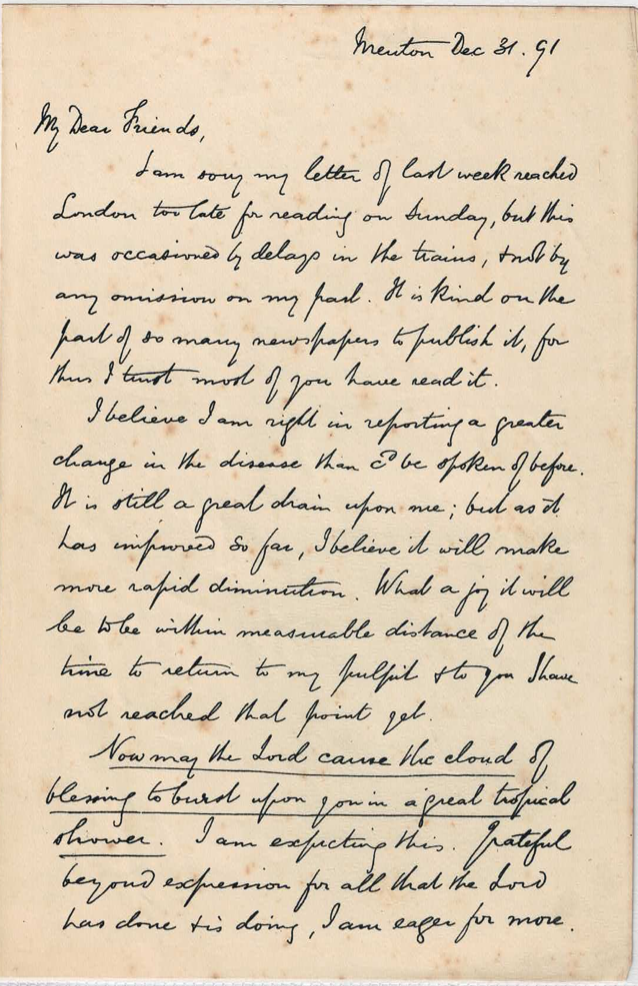
Menton Dec. 31. 91

My Dear Friends,

I am sorry my letter of last week reached London too late for reading on Sunday, but this was occasioned by delays in the trains, & not by any omission on my part. It is kind on the part of so many newspapers to publish it, for thus I trust most of you have read it.

I believe I am right in reporting a greater change in the disease than could be spoken of before. It is still a great drain upon me; but as it has improved so far, I believe it will make more rapid diminution. What a joy it will be to be within measurable distance of the time to return to my pulpit & to you. I have not reached that point yet.

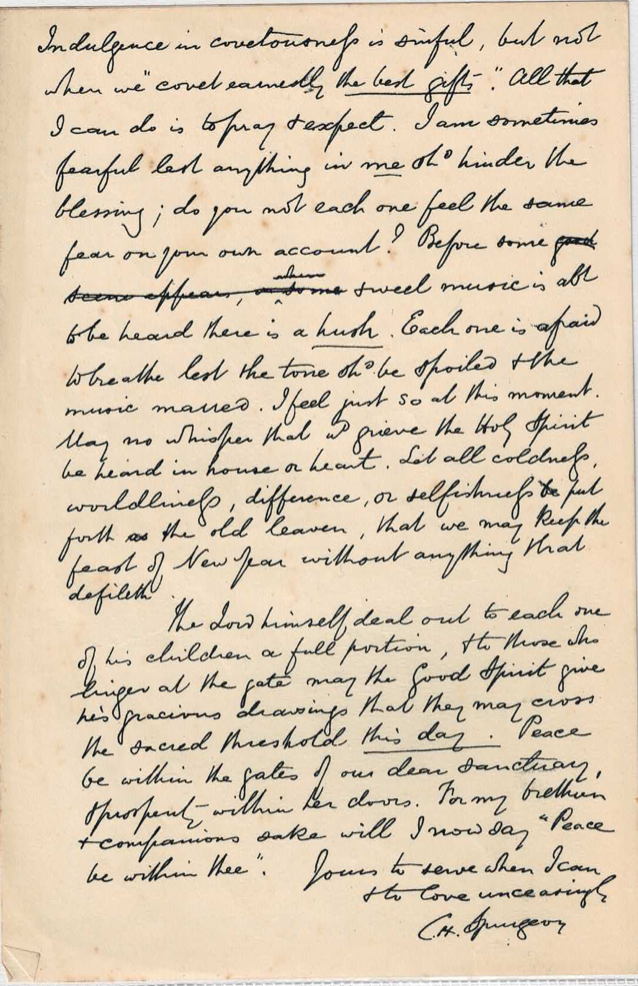
Now may the Lord cause the cloud of blessing to burst upon you in a great tropical shower. I am expecting this. Grateful beyond expression for all that the Lord has done & is doing, I am eager for more. Indulgence in covetousness is sinful, but not when we “covet earnestly the best gifts.” All that I can do is to pray & expect. I am sometimes fearful lest anything in me should hinder the blessing; do you not each one feel the same fear on your own account? Before some sweet music is about to be heard, there is a hush. Each one is afraid to breathe lest the tone should be spoiled & the music marred. I fell just so at this moment. May no whisper that would grieve the Holy Spirit be heard in house or heart. Let all coldness, worldliness, difference, or selfishness be put forth as the old leaven, that we may keep the feast of New Year without anything that defileth.

The Lord himself deal out to each one of his children a full portion, & to those who linger at the gate, may the Good Spirit give his gracious drawings that they may cross the sacred threshold this day. Peace be within the gates of our dear sanctuary, & prosperity within her doors. For my brethren & companions sake will I now say, “Peace be within thee.”

Yours to serve when I can & to love unceasingly,

C. H. Spurgeon


[1] For an account of Spurgeon’s last days and his funeral, see From Mentone to Norwood: The Final Journey of C. H. Spurgeon

[2] Spurgeon’s last sermon to his people was preached on June 7, 1891 The Statute of David for the Sharing of the Spoil


Spurgeon’s Parting Pastoral Words – Dec. 24, 1891

By / Jun 27

The final weeks of Spurgeon’s life were spent in sunny Menton, in southern France. Throughout his ministry, he had gone there to recover from his various ailments and overwork. Now, in the fall of 1891, Spurgeon was there once again. Under the care of his wife Susie and skilled doctors, the congregation fully expected him to recover and return to London to continue his famous ministry at the Metropolitan Tabernacle. Spurgeon himself held on to this hope. But this was not to be. On January 31, 1892, Spurgeon went to be with the Lord.[1]

Throughout his ministry, Spurgeon wrote many letters to his congregation during his travels. Even when traveling abroad, visiting new places, and preaching before thousands, Spurgeon never forgot his own church. In his letters to them, we see the affection of a pastor for his people, his confidence in his elders and deacons, and his dependence on his people for their prayers. During his final trip to Mentone, Spurgeon committed to writing a weekly letter back to his people, updating them on his situation and encouraging them to persevere. These letters comprise Spurgeon’s final pastoral words to his people.[2]

Over the next four weeks, we will be publishing Spurgeon’s last letters to his congregation, beginning on December 24 and ending on January 14. While nobody expected these to be his last words to his church, they are a fitting conclusion to his pastoral ministry. In them, we see Spurgeon’s confidence in God’s sovereign grace, even apart from his own ministry. We see Spurgeon’s call for his people to persevere in the truth of the gospel. And we see his evident love for them. In other words, what characterized Spurgeon’s ministry from the very first day continued to his last breath. May the same be true of pastors today.


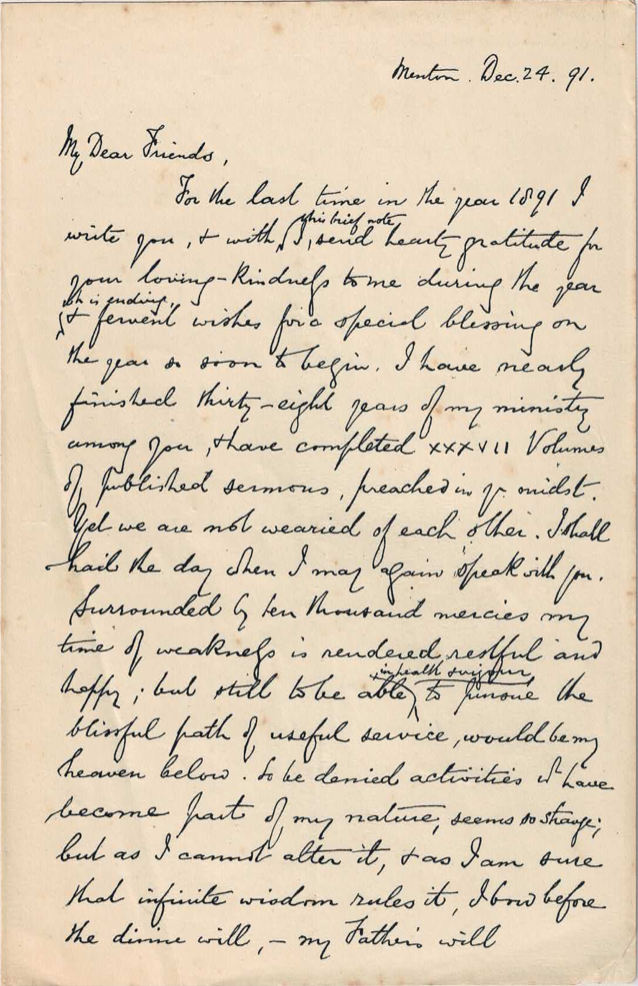
Menton. Dec. 24. 91.

My Dear Friends,

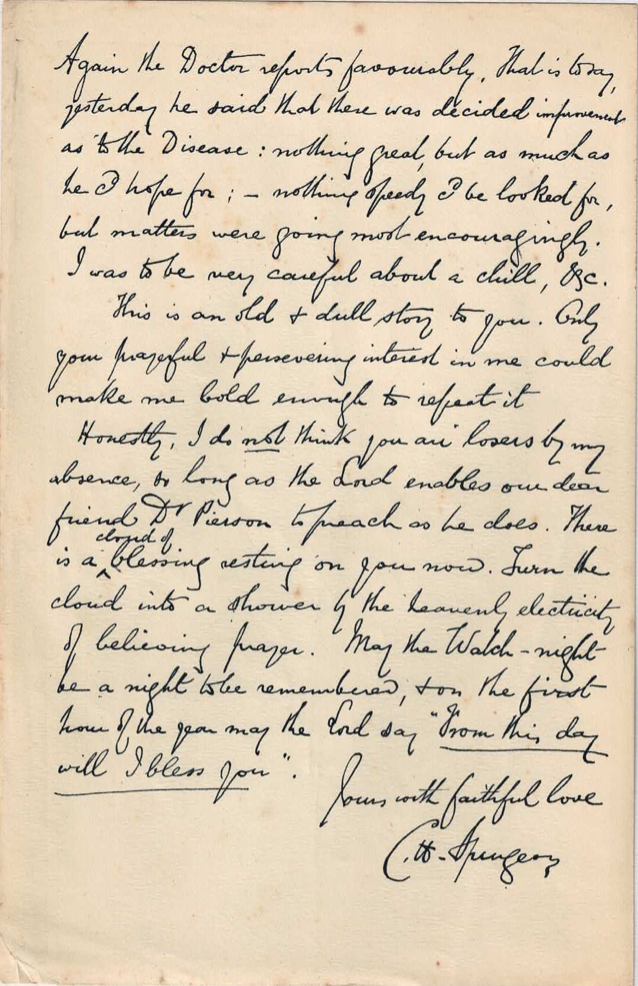
            For the last time in the year 1891 I write you, & with this brief note, I send hearty gratitude for your loving-kindness to me during the year which is ending & fervent wishes for a special blessing on the year so soon to begin. I have nearly finished thirty-eight years of my ministry among you, & have completed XXXVII volumes of published sermons, preached in your midst. Yet we are not wearied of each other. I shall hail the day when I may again speak with you. Surrounded by ten thousand mercies my time of weakness is rendered restful and happy; but still to be able in health & vigour to pursue the blissful path of useful service, would be my heaven below. To be denied activities which have become part of my nature, seems so strange; but as I cannot alter it, & as I am sure that infinite wisdom rules it, I bow before the divine will, — my Father’s will. Again the Doctor reports favourably, that is to say, yesterday he said that there was decided improvement as to the disease; nothing great, but as much as he could hope for; — nothing speedy could be looked for, but matters were going most encouragingly. I was to be very careful about a chill, etc.

            This is an old & dull story to you. Only your prayerful & persevering interest in me could make me bold enough to repeat it.

            Honestly, I do not think you are losers by my absence, so long as the Lord enables our dear friend Dr. Pierson to preach as he does. There is a cloud of blessing resting on you now. Turn the cloud into a shower by the heavenly electricity of believing prayer. May the Watch-night be a night to be remembered, & on the first hour of the year may the Lord say, “From this day will I bless you.”

Yours with faithful love,

C. H. Spurgeon


[1] For an account of Spurgeon’s last days and his funeral, see From Mentone to Norwood: The Final Journey of C. H. Spurgeon

[2] Spurgeon’s last sermon to his people was preached on June 7, 1891 The Statute of David for the Sharing of the Spoil


Highlights from The Sword & the Trowel 1880-1884

By / Sep 28

In 1884, as The Sword & the Trowel finished 20 years of publication and Spurgeon turned 50, the ministry at the Metropolitan Tabernacle was in full swing. The Pastors’ College was a regular feature of the magazine, as graduates reported back on the progress of their work. Reports from Stockwell Orphanage encouraged the readers as they supported that ministry to orphans. Conversion stories from the Colporteurs and other evangelists also encouraged readers in their own evangelistic efforts and prayers for the lost. Other charitable ministries, like Mrs. Spurgeon’s Book Fund, were also regularly featured. And Spurgeon’s sermons, as always, provided an ongoing source of spiritual encouragement.

Yet all was not well. As always, these ministries faced their ups and downs. College graduates sometimes experienced disappointment and little fruit. Missionaries returned from the field sick and discouraged. Finances for the orphanage and college were often tight. And Spurgeon continued to struggle with poor health. Beyond these challenges, there loomed a dark cloud over the horizon. Writing in 1883, Spurgeon observed,

The enemy is gathering strength, and mustering his bold forces for fiercer attacks. What doctrine is now left unassailed? What holy thing is regarded as sacred? Truths once regarded as fundamental, are either denied, or else turned inside out till nothing of their essence remains. Holy Scripture is no longer admitted to be the infallible record of revelation, but is made to be a doormat for “thought” to wipe its shoes upon. Every sign of the times warns us of a desperate conflict for all that is precious and vital in our religion.

Here in these issues of The Sword and the Trowel, we see an active, fruitful church, but we should not imagine it to be a well-oiled machine running smoothly without a hitch. Rather, Spurgeon knew that all these enterprises depended on the prayers and support of God’s people. Ultimately, they depended on God’s grace for fruit. Together, they worked to build up the church and fight against evil.

Here are just a few highlights from these five years. As you read through these issues, send us a note on Twitter (@SpurgeonMBTS) if you find anything interesting!

(To jump straight to the article, click on the link, then click the “View this Resource” button.)

1880

Praise of Men – The fear of man is a snare, especially in the ministry. Beware!

A man who becomes dependent upon the opinions of others lays himself open to contempt. It is impossible to think highly of a person who fishes for compliments. To value esteem so much as to go out of our way after it is the surest possible way to lose it. When we consider how unevenly the human hand holds the balances, we may feel but small concern when we are weighed by our fellow-men. If we consider how infinitely precious is the divine regard, we shall live to gain it, and so shall rise above all slavish consideration of the opinions of our fellows.

Against Hastening to Remove From Our Post of Duty – Are you tempted to leave your ministry position? Consider Spurgeon’s encouragement to persevere.

Has the minister just entered upon a fresh sphere, and does he miss the affectionate warmth of his old acquaintances? Does he find his new people strange and singular? Do they appear cold and distant? Let him persevere, and all this will wear off, and he will come to love the very people to whom he now feels an aversion, and find his best helpers among those who now seem to be utterly indifferent to him. The call of Providence has brought him where he is, and he must not venture to leave because of inconveniences; often it will be his wisdom to regard these as a part of the tokens that he is in the right way, for the appointed path is seldom easy to the feet.

1881

Young Preachers Encouraged – For those starting out in their preaching, here is some encouragement from Spurgeon. For those who are further along in your preaching, how can you raise up more preachers?

I am not old enough to have forgotten the struggles of my own early days, or the influence of a cheering word upon my young heart, and so I take a loving and lively interest in those who sincerely endeavor to do their best for their Master, even though that best be raw and uncouth. “Would God that all the Lord’s servants were prophets,” and that far greater numbers of laborers were sent into the harvest of the great Householder.

C. H. S. on “Taking the Bull by the Horns” – A parable for pastors who are prone to confrontation and conflict in the church.

THERE was a little trouble in the church, and the young minister was sad about it. He sought advice, and one who loved peace begged him to let the matter alone, and in a short time the evil would die of itself, for, as Solomon says, “Where no wood is the fire goeth out.” The brother was of a fretful spirit, and could not take things quite so easily; it worried him that there should be a single weed in his garden, and he felt he would sooner plough it all up than let that weed remain.

1882

Two Prayer-Meetings at the Tabernacle & Two more Tabernacle Prayer-Meetings – The prayer-meetings at the Tabernacle were the engine of the ministry of the church. Here are accounts of two recent meetings at the Tabernacle, offered as a suggestion for pastors to consider as they planned their own prayer meetings.

IT has been thought that an account of Tabernacle Prayer-meetings might be useful to those who conduct these holy gatherings elsewhere. It will exhibit the great variety of which such meetings are capable, and may suggest to friends who complain of dull prayer-meetings methods for curing such a grievous ill. We do not set up our prayer-meetings as models, but merely as suggestions. We give only two meetings, but we hope to continue the account next month.

1883

How to Attract a Congregation – Spurgeon rejected the seeker-sensitive strategies of his day and proposed an alternative for his students to follow, namely the preaching of the gospel.

Among the absurd articles which have appeared lately, I noticed one which gravely asserted that in our colleges young ministers are taught everything but their main business: that main business being the art of attracting a congregation. Is not that a remarkably wise remark? Surely, a Daniel has at last come to judgment. Not taught how to attract a congregation. What a grievous omission! Surely a subscription should be commenced, and a chair founded for this neglected department of practical theology. Who shall occupy the aforesaid chair? Let us hope it will be a good arm-chair, well made, and daintily stuffed for the benefit of the professor who is to sit in it; but what will he do in return for his endowment? What text-book will he use? Into what divisions will he apportion his scientific observations? I am lost in conjecture. Assuredly, I am not a candidate for the proposed office.

1884

In my Fiftieth Year and Getting Old – When Spurgeon began his pastorate in London at the age of 19, his request to his congregation was that they would pray for him in his youthfulness. Now at the age of 50, Spurgeon reflects on the temptations and challenges of old age and once again asks his church to pray for him.

When all is said and done, the jubilation of our Jubilee does not call for any great blowing of trumpets, but rather for uplifting of hand and heart in prayer to God for further help. It may be that we are only in mid-voyage. May that voyage end in landing our freight in port, and not as some life-passages have terminated, namely, in an utter wreck of every hope! Our friends and fellow-helpers will, we trust, supplicate on our behalf that we may receive a fresh anointing from on high, and we will begin life again without fear.


“Dumb Dogs” in the Pulpit: Spurgeon on Borrowed Sermons

By / Jul 5

Iain Murray once observed that Spurgeon wrote and preached so much that people can basically cherry-pick quotes from his works to support virtually any position, even those he would’ve adamantly opposed. Such has been the case with the topic of plagiarizing sermons recently. Every few years, this controversy resurfaces. Some are quick to condemn it, while others attempt to provide a more nuanced response. Sometimes, the latter will point to examples in church history of those who plagiarized sermons, and among those listed is Spurgeon. Did Spurgeon support preaching borrowed sermons?

Spurgeon repudiated plagiarism in the pulpit

Spurgeon was a remarkably original preacher. While ministers in the Church of England still read sermons from the book of homilies, Spurgeon believed that the preacher should depend not on pre-written sermons but the Holy Spirit. This dependence took place not only while preaching but even in sermon preparation. At the heart of Spurgeon’s rejection of plagiarism was his deep conviction that preaching should be led by the Spirit.

Amid a full ministry schedule during the week, Spurgeon carved out time late into the night on Saturdays to work on his sermons. In his lectures to his students, we see that prayerful dependence was at the heart of his preparations.

To me still, I must confess, my text selection is a very great embarrassment— embarras de richesses, as the French say—an embarrassment of riches, very different from the bewilderment of poverty—the anxiety of attending to the most pressing of so many truths, all clamoring for a hearing, so many duties all needing enforcing, and so many spiritual needs of the people all demanding supply. I confess that I frequently sit hour after hour praying and waiting for a subject, and that this is the main part of my study. (Lectures 1:88)

Spurgeon would spend much of the night studying the Scriptures, trying out different “skeletons” (sermon outlines), and praying for the Spirit to guide him in preparing the sermon. During his study, Spurgeon consulted commentaries and other writers, but never as a substitute for the Spirit’s leading. In the end, he looked for spiritual guidance. “Many ministers appear to think that they are to choose the text; they are to discover its teaching; they are to find a discourse in it. We do not think so.”

How different was Spurgeon’s approach from those who simply borrowed another’s sermon!  Spurgeon often rebuked preachers of his day for reading other’s sermons as their own, rather than prayerfully preparing one for their people. To do so was to forego the Spirit’s work in the preacher. Spurgeon clearly repudiated such a practice, and he spoke about it clearly.[1]

Spurgeon believed that those who preached borrowed sermons did so for their own ease and convenience.

There are still plenty who hardly know anything about the gospel. They preach about a great many things, but little or nothing about Jesus Christ. They buy their sermons cheaply, and preach them at their ease; they ask God to teach them what to say, and then pull their manuscripts out of their pockets! We have had to mourn, especially in years gone by, that we could look from parish to parish, and find only “dumb dogs” in the pulpits. And some men, who might have spoken with a little earnestness, if they had liked, let the people slumber under them, instead of preaching the Word with true fidelity, remembering that they will have to give account to God at the last. (MTP 45; Sermon No. 2625)

It is no use for a man simply to have a curacy or something of that sort, buy his manuscripts cheap, come up and read off two sermons twenty minutes long, go home with a good conscience that he has done duty twice, and then say, “Let the whole earth be filled with his glory.” … But you shut yourself up in your study, or what is ten times worse, you do nothing at all, but just take it easy all the week till the Sunday comes, and then borrow a sermon out of an old magazine, or buy one of the helps for ministers, or take down one of Charles Simeon’s skeletons and preach it. My good man, you cannot pray in that fashion. (NPSP 3: Sermon No. 129)

Such preachers asked God for help in their preaching, but their use of bought sermons contradicted their prayers. Their concern was more for their convenience rather than the glory of God, and as a result, the sermons they preached were usually poor and lacking Christ.

Preaching borrowed sermons robs the congregation of a minister who has known the truth of God’s Word firsthand.

In order that you may impress the Word upon those to whom you preach, remember that it must be impressed upon yourself first. You must feel it yourself, and speak as a man who feels it, not as if you feel it, but because you feel it, otherwise you will not make it felt by others. I wonder what it must be to go up into the pulpit, and read somebody else’s sermon to the congregation. We read in the Bible of one thing that was borrowed, and the head of that came off; and I am afraid that the same thing often happens with borrowed sermons – the heads come off. Men who read borrowed sermons positively do not know anything about our troubles of mind in preparing for the pulpit, or our joy in preaching with the aid of only brief notes. (Soul Winner, 92)

Borrowed sermons — pages of other people’s experience — fragments pulled from old or new divines — nothing of their own, nothing that God ever said to them, nothing that ever thrilled their hearts or swayed their souls, — God will not own such teaching as this. (MTP 42; Sermon No. 2460).

A borrowed sermon may have someone else’s experience.  But it doesn’t have the preacher’s experience. Those truths have not been impressed on the preacher. He can only preach “as if” he feels it, not “because” he feels it. As a result, the congregation suffers, and “God will not own such teaching as this.”

God will call preachers to account for preaching Christ-less, borrowed sermons.

Oh the curse on the other hand, that shall rest on a man who, in his last moments, shall have to reflect – “I preached other men’s sermons, and talked of anything but Christ; I lifted up anything but the Lord!” (MTP 8:461)

For such preachers, it won’t matter that these sermons were not their sermons. “They will have to give account to God at the last” for their laziness and for every word of these borrowed sermons.

As one who preached at least four times a week, Spurgeon could easily have lightened his load by preaching borrowed sermons. Even more, as one who often preached away, he could’ve lightened his load by taking old sermons and re-preaching them (though this would’ve likely been detected, given how popular his printed sermons were!). But whether in his own pulpit or away, Spurgeon did not want to rob himself of an opportunity for prayerful dependence on the Spirit. Similarly, Spurgeon encouraged the preachers of his day to repudiate plagiarism and to preach their own sermons.

Spurgeon commended the proper use of printed sermons

Having said all that, Spurgeon lived during the age of printed sermons, and he himself published and sold hundreds of thousands of sermons. Certainly, he believed that there were exceptions where a preacher may read a printed sermon in the pulpit appropriately. People have cited these instances as Spurgeon’s support for plagiarizing sermons, but in fact, these would only be exceptions to the rule.

One exception of this is for those who are just starting in their preaching. Early in his preaching career, when he was seventeen, Spurgeon discovered how instructive it was for him to borrow sermon outlines from preachers like John Gill, Charles Simeon, and others. Spurgeon drew heavily from these sources to fill out his preaching outline, but in the end, given that his outline was only a few pages long, he likely still had to fill out his sermon with much of his own extemporaneous insights and comments. As a young teenager learning to preach, these pre-written sermon outlines provided a helpful starting point. By the time he began pastoring in London, he had preached nearly 700 sermons, and though he was still only nineteen, he no longer needed to rely on Gill and others as he did in his early years.

This would be a practice that he later supported also. In 1877, he visited Bristol College and donated a set of his sermons to the college. One person records the event,

He thought the books he gave would be useful to students, as most of them were sermons; “and if any brother would like to preach them (continued Mr. Spurgeon) I hereby decree he shall not be guilty of plagiarism, as I hand them over to be the property of the college.” (Speeches at Home and Abroad, “Earnest Students”)

Note that Spurgeon here makes an exception. Typically, a preacher preaching another’s sermon would be “guilty of plagiarism.” But in this case, because these are students who are learning to preach, he was happy to grant an exception. Eventually, however, Spurgeon insisted that his own students learn to prepare and preach their own sermons. During their studies at the Pastors’ College, students had to prepare and deliver at least one original sermon for critique. On one occasion, a student attempted to plagiarize his sermon.

It has long been our rule that each brother should read in the College at least one discourse which he has himself composed, and which his comrades are expected to criticize. Any attempt at plagiarism would, therefore, be manifestly unfair; and, if detected, would meet with well-merited condemnation. One man, when it came to his turn, was actually reckless and foolish enough to take one of my printed sermons, — I suppose condensed, — and to read it as though it had been his own composition; and he had to thank his brethren that he was not instantly expelled from the Institution, Several of them at once recognized the discourse; and, as soon as the time for criticism arrived, proceeded to pull it to pieces most mercilessly.

They found fault with the introduction, the divisions, the subdivisions, the illustrations, the application, — with everything, in fact, except the doctrine; — I think that was all right! I was so pleased with the critical acumen displayed that I forgave the offender; but I let it be distinctly understood that, for the future, any student repeating the offense, whether with my sermon or anyone else’s, would be forthwith dismissed in disgrace. (Autobiography 3:148)

Spurgeon dealt graciously with this student but also made it clear that such future action would result in expulsion “in disgrace.”

Another story has been raised concerning Spurgeon’s students and plagiarism. Lloyd Jones tells the story of another student who was caught plagiarizing a sermon, which was thought to belong to Spurgeon. As it turns out, it belonged to William Jay of Bath, but the headings and content matched Spurgeon’s!

“’Wait a minute,’ said Spurgeon, and turning to his library, he pulled out one of the volumes and there was the sermon, the exact sermon-the same text, the same headings, the same everything! What had happened? The fact was that Mr. Spurgeon had also preached William Jay’s sermon and had actually put it into print with other sermons of his. Mr. Spurgeon’s only explanation was that it was many years since he had read the two volumes of Jay’s sermons and that he had forgotten all about it. He could say quite honestly that he was not aware of the fact that when he had preached that sermon he was preaching one the sermons of William Jay. It had registered unconsciously in his memory. The student was absolved of the charge of preaching one of Mr. Spurgeon’s sermons, but was still guilty of theft!” (Preaching & Preachers, 294)

I haven’t been able to track down the source of this anecdote, so it’s not clear how accurate it is. Even so, it’s worth observing that Spurgeon firmly opposes plagiarism even in this story. First, the student who consciously used Jay’s sermon was still “guilty of theft.” Second, Spurgeon did not consciously plagiarize Jay, which is why he tried to explain it. Somehow, through his own sermon preparation, Spurgeon had arrived at the same sermon outline as Jay, and in his delivery, he extemporaneously delivered much of the same content. All this happened, remarkably, from being unconsciously influenced by reading Jay’s sermon many years ago. This raises the related but separate issue of unconscious plagiarism… if you have a photographic memory like Spurgeon, watch out! Had he known, Spurgeon would not have done it. But as it is, he unintentionally erred. In the end, it’s clear that Spurgeon did not intend to copy Jay and would still charge sermon plagiarism as theft.

The other exception that Spurgeon might have allowed was on occasions where an inexperienced deacon or layperson read a printed sermon at a Christian gathering because a preacher is unavailable. The stories abound of sailors reading Spurgeon sermons on the high seas or miners gathering in Colorado on a Sunday to hear a Spurgeon sermon. Many were converted on such occasions, and Spurgeon was always glad to hear these stories. Even in such cases, however, the preacher or reader should have made it clear that this was a printed sermon, rather than original to the preacher (which would’ve been obvious in the case of miners and sailors). But on one occasion, he was willing to excuse a lay preacher who clearly passed off one of Spurgeon’s sermons as his own.

I remember once feeling many questions as to whether I was a child of God or not. I went into a little chapel, and I heard a good man preach. He was a simple workingman. I heard him preach, and I made my handkerchief sodden with my tears as I heard him talk about Christ, and the precious blood. When I was preaching the same things to others I was wondering whether this truth was mine, but while I was hearing for myself I knew it was mine, for my very soul lived upon it. I went to that good man, and thanked him for the sermon. He asked me who I was. When I told him, he turned all manner of colors. “Why,” he said, “Sir, that was your own sermon.” I said, “Yes, I knew it was, and it was good of the Lord to feed me with food that I had prepared for others.” (MTP 32, Sermon No. 1877)

Spurgeon loved Jesus. And he understood that God could use even a borrowed sermon to glorify His Son. Such was the case in the story above. The “simple workingman” had plagiarized his sermon (and was clearly embarrassed by it). Spurgeon did not commend the practice but humbly thanked him for the sermon and praised God for using it for his encouragement.

But Spurgeon was no pragmatist. Though God could work through a plagiarizing preacher, He did so despite the preacher’s dishonesty and laziness. For himself, he sought to maintain a prayerful dependence on God by only preaching his own sermons, and he urged his students and other pastors to do the same.


[1] Many thanks to Phil Johnson, a friend of the Spurgeon Library, for compiling these and many other quotes.


God’s Firebrands

By / Jan 19

A Sermon Published on Thursday, January 19, 1911.
Delivered by C.H. Spurgeon, at the Metropolitan Tabernacle, Newington.

“Is not this a brand plucked out of the fire?”- Zechariah 3:2

It may be well to explain these words, for, simple as they are, a few words of exposition may be useful to open up the metaphor, and enforce the thrilling truth that underlies it.

There is mention of a fire. A cry of “FIRE!” has something fearful in it. When a fire begins to get the upper hand with us, it is terrible in its destructiveness. The fire here meant is more awful than any flame that makes havoc of matter, and its devastations are ten thousand times more appalling. It is the fire of sin. It blazed in the heart of an angel, and he became a devil. Its sparks fell into the bosom of mother Eve, and into the heart father Adam, and paradise was burned up, and the world became a wilderness. Sin is a fire which destroys the comfort of mankind here, and all the joy of mankind hereafter. It is a flame which yields no comfortable warmth. The sinner may dance in the light of it for a moment, but in sorrow will he have to lie down in it for ever. Woe unto those who have to make their bed in this fire, to dwell with these consuming flames for a term that knows no ending!

There is, further, mention of a brand. Nothing can be more suitable to burn in the fire than a brand. It is not a brand just taken from the tree, fresh and full of sap; it is a brand, -dry, sere timber, fit for the burning; it is not a mass of stone or iron, but a combustible brand. And who does this indicate but man’s natural heart, which is so congenial to the fire of sin? Our heart is like the tinder, and Satan has but to strike the spark, and how readily does the spark find a nest within our bosom! As the firebrand fits the fire, so does the sinner fit in with sin. When sin and the sinner come in contact, it is “Hail fellow, well met!” They are boon companions. The sinner’s heart is the nest well prepared, and sins are the foul birds which come to nestle there. Not to go a step without a particular application, it will be well for us all to understand that we are ourselves like the brands; there is a fitness between us and sin; if we burn in the fire of sin, it is no wonder; with our fallen nature, it is no greater marvel that we should be instigated by sin than that the firebrand should kindle in the flame.

Beyond the distinct allusion to a fire and a brand, we read of a brand in the fire. Nor is it merely a brand hitherto lying upon the heap, to be by-and-by put upon the flames; it is “a brand plucked out of the fire.” It has been in the fire. Does not this portray our condition, -not only congenial for the fire of sin, but actually burning and blazing in it? We began very early. Disobedience to parents, angry tempers, petty falsehoods, many sorts of childish obstinacies and wrongdoings,-all these were like the first catchings on fire of the brand. We have blazed away the reverse of merrily since then; some have become charred with sin, till their very bodies contain the marks of that tremendous fire, while in every case the soul receives a charring and blackened from the flame. Not one of us has been able, even with godly training and Christian parentage, to escape from burning to some extent in this fire. Alas! alas! for those who are even now in it!

There is a fair side to the picture; it is not altogether gloomy. While we have a fire, and a brand, and a brand in the fire, we also have, blessed be God! a brand plucked out of the fire. Sinners these, who, though they have still within them the propensity to sin, are no longer in the fire of sin. They have been taken away from it. They sin through infirmity, but willful sin they do not commit. Their nature has been challenged. They have received the renewing grace of God. The fire that once burned within them has been quenched. They recollect, to their grief and sorrow, the mischief that sin did to them, but it is not doing them the same mischief now. They are delivered from the body of sin and death.

Still, the force of the passage seems to lie in the words “plucked out of.” You may sit down on the settle by the hearth in one of those good old country fireplaces where they still burn the logs, and perhaps a brand drops out upon the hearth, where it flames a little while, and then goes out. This is not a picture that we can appropriate, for there never was an instance known of a man by himself dropping out of the fire of sin. Alas! we love it too well. “The burnt child dreads the fire,” says the proverb; but we are like the silly moth that flies at this candle, and singes its wings, yet still uses those wings to mount up again into the flame; and if it falls, all full of pain and torment, with burnt legs, and with almost all its wing gone, it struggles, it pants, it labors to get into the fire again. Such is man. He loves this fire which is his destruction. In youth, we put our finger into the flame. We feel that it is burnt, yet again we put our hand into it. Then, in after years, we persist deliberately till that sin has consumed us from head to foot, and we lie down in our grave with our bones, filled with disease, -foul fruit of the sins of our youth, our very corpses in their mortality bearing witness to the corruption of our morals.

Albeit the Christian is relieved of that peril, he does not escape by his own free will. He is plucked out of it. To be plucked out, there needs a hand quick to rescue. You know that pierced hand, and how it burnt itself when it was thrust into the hot coals to pluck us out like brands from the burning. It was no use waiting till we dropped out, for we should never have done so; there was no hope of that. With all the appliances of grace and of judgment, the two together could not bring us out. But effectual vocation did it, when the Spirit of the living God took the firebrand in his hand, and without asking it whether it would or not, by the sweet and irresistible compulsions of divine grace plucked the brand out of the fire. Now, every believer in the Lord Jesus is a trophy of the strength as well as of the mercy of God. It took as much omnipotence to snatch him from the fire as it needs to make a world, and every believer may feel that he is a brand plucked from the fire.

This question, as it appears to me, will bear three renderings; first, it may be looked upon as an exclamation of wonder: “Is not this a brand plucked out of the fire!” Secondly, as an enquiry or hope: “Is not this a brand”- this one particularly,- “plucked out of the fire?” And, in the third place, it is certainly a defiance for us, assured of our safety, to throw into the face of Satan, the accuser: “Is not the a brand plucked out of the fire?”

I. THE TEXT BEARS THE SENSE OF WONDERMENT: “Is not this a brand plucked out of the fire?”

It was said of Joshua, the high priest. There was such astonishment at his preservation that, with hands uplifted, the question was asked, “Is not this man just like a firebrand snatched from among the glowing coals?” Nor is this marvel confined to Joshua. I believe this is a matter of wonder in the case of every saved sinner. Was there ever a man saved by grace who was not a wonder? Is not every Christian conscious that there is some peculiarity about his own salvation which makes it marvelous? If you cannot all chime in with “Yes,” I must at least lead the chorus, in which an overwhelming multitude will join, confessing that it was so with myself. For a long while, I could not believe that it was possible that my sins could be forgiven. I do not know why, but I seemed to be the odd person in the world. When the catalogue was made out, it seemed to me that, for some reason, I must have been left out. If God had saved me, and not the rest of the world, I should have wondered indeed; but if he had saved all the world except me, that would have seemed to be according to the common course, and a right course, too. And now, being saved by grace, I cannot help saying, “Yes, I am a brand plucked out of the fire!” And does not each believer say the same? Why, look at the believer. He is fallen, lost, and yet, though lost in his first parent, he is saved in Christ. The believer’s own nature is depraved like that of other men, and yet, contrary to nature, he is made a new creature. As though Niagara were suddenly made to leap upwards instead of falling downwards, our nature, so mighty for sin, has been suddenly turned into the opposite direction, and we have been constrained to seek after grace and holiness.

Out of the state of our natural depravity we have been plucked, so that every man who is delivered from its sway may well say, “Am not I a brand plucked out of the fire?” Each Christian, knowing his own heart, and having a special acquaintance with his own peculiar besetting sin, feels as if the conquest of his own will by the grace of God were a more illustrious trophy of that grace than the conquest of a thousand others. I can well understand that none of us will yield the palm in heaven to any other as to our indebtedness to the mercy of God. You may sing, and sing loudly, each one of you, and each one say “I owe more to God’s grace then any other owes;” but there is not one of us who will concede the point. We shall each strike up our own peculiar note, and louder get, and louder yet, and louder still our notes of gratitude will rise to the seventh heaven “unto him that loved us, and washed us from our sins in his own blood: to whom be glory and dominion for ever and ever.” Each Christian, then, for some reason, will feel that he is peculiarly “a brand plucked out of the fire.” I envy not the feeling of any believer who should dispute this. May you and I be more thoroughly baptized into the spirit of humility, that with deeper gratitude we may feel how peculiarly we are indebted to the grace of God!

Though this is the case universally, there are instances so uncommon that they excite, surprise in the minds of all who hear of them. In the cases off extraordinary conversion, one of the first is the salvation of the extremely aged. Imagine a person here who has lived to be seventy or eighty years old, and all this time, his heart has never heard the sigh of repentance, and never felt the joy of pardon. You have lived only to cumber the ground all these years, and you are still an enemy to God; while on the borders of the grave you have no hope of heaven. O soul, your case is very sad! It were enough to make angels weep, if weep they could, to think that such an one as you, after so many years of longsuffering, should not be melted thereby. Now, suppose the Lord should appear to you tonight, and say to you, “I have loved thee with an everlasting love: therefore with lovingkindness have I drawn thee. I took thee into the house of prayer tonight on purpose that the Word might come with power to thy soul, and I have this to say to thee,-Come now, and let us reason together: though thy sins be as scarlet, they shall be as white as snow; though they be red like crimson, they shall be as wool.” What, sayest thou, thou hoary Jacob, but without Jacob’s faith, leaning upon thy star, would it not be a wonder if now thou shouldst begin to love the Lord, and begin to believe in Jesus? Oh, may God give thee grace to do so, and then I am sure thou wilt say to thy kinsfolk and acquaintance, “Is not this a brand plucked out of the fire?”

There have been instances of persons converted at the most advanced age. There was one who went, I believe, to hear Mr. Toplady preach the very day when he was aged a hundred. He had been a constant neglecter of the house of God, but when he arrived at the age of a hundred, attracted by the fame of Mr. Toplady, who was an exceedingly popular, as he certainly was a highly evangelical preacher, and happened to be preaching in the town where the man lived, he said he would go on that day to hear him, that he might recollect his birthday. He went, and that day God in his grace met with him. I remember, too, the instance of a man who was converted by a sermon which he heard Mr. Flavel preach, and which was blessed to him eighty-three years after he had heard it, when he was at the age of ninety-eight. The Word came with power to his soul after all that interval of time. Just as he was on the borders of the tomb, he was made to enter into eternal life. May the God of infinite mercy give such a blessing to aged ones here, and they will be brands plucked out of the fire!

Remarkable, too,- I might almost say exceptional, – is the conversion of people who have been accustomed to hear the gospel from their youth up, who, though not, perhaps, absolutely aged, have nevertheless been for years receiving gospel privileges without any result. They have been lying at Bethesda’s pool, with its many porches, now for forty or fifty years. Oh! there are some such here. You have not heard me all that time. Some other ministry has, in times past, fallen upon your ear, anti perhaps our own voice is now familiar to you through your having heard it these ten or twelve years. You listened to it at first with attention. You were riveted for a little while. Then it grew to be an ordinary thing; and though still you give the preacher a fair hearing, there is very little of that drinking in of the Word which there once seemed to be. Some of you, perhaps, will almost go to sleep here now. I wish sometimes that you were elsewhere; perhaps another voice, would make your ears to tingle; you know my voice full well. It is quite possible, for a minister to preach too long to any one set of people, if they get so accustomed to, the tones of his voice that they are never aroused. The “click, click” of the mill gets to be so to the miller that he goes to sleep. Over in Bankside, I am told, when a man is first put inside a boiler while this rivets are being fastened, he cannot stop long, the noise is so dreadful; but, after a time, the boilermaker gets so used to the horrible din that he can almost go to sleep inside. Well, now, so it really is under any ministry when the people get gospel-hardened. The same sun which melts wax hardens clay. The influences which tend to make some people better make other people a great deal worse. Some of you have thus trifled with your own conscience. Should you be saved tonight, you would be brands plucked out of the fire, and may we not, hope that you shall be? Will not some of us pray for it?

Further still, and apparently the wonder increases, there have been cases of gross sinners in which this marvel has been still more exciting. It is a merciful thing that God forgives drunkenness. Some of those who have wallowed in it have been saved. We sometimes talk of a man being “as drunk as a beast,” but who ever heard of a beast being drunk? Why it is more beastly than anything a beast ever does. I do not believe that the devil himself is ever guilty of anything like that. I never heard even him charged with being drunk. It is a sin which has no sort of excuse; those who fall into it generally fall into other deadly vices. It is the devil’s backdoor to hell, and everything that is hellish; for he that once gives away his brains to drink is ready to be caught by Satan for anything. Oh! but while the drunkard cannot have eternal life abiding in him while he is such, is it not a joy to think of the many drunkards who have been washed and saved? This night, there are sitting here those who have done with their cups, who have left behind them, their strong drink, and who have renounced the haunts of their debauchery. They are washed and cleansed; and when they think of the contrast between, where they used to be on Sunday night and where they are now, they give an echo to the question, “Is not this a brand plucked out of the fire?”

Very frequently, where this sin comes, blasphemy is added to it; and how many we have, who, though now saved by grace, were once fearful swearers, and could defy the God that made them to destroy them, or to, inflict the most horrible judgments upon them, which it were a shame even to mention! But almighty grace takes the swearer, and says to him, “You shall curse no longer, for I have blessed you; I do not intend that you should imprecate curses on yourself; you shall now begin to plead with me for saving mercy!” Many, many, many such, whose tongues might well have rotted in their mouths through blasphemy, have been cleansed by Jesus’ blood; and the tongue can now sing that once could curse, and the lips can now pray that once could utter oaths. “Is not this a brand plucked out of the fire?” Oh! you are here, Jack, are you? You can swear. Sometimes, when you are at sea, you roll out an oath or two; and when you are on shore, you know what you are; but may my Master meet you, and may he once for all transform you, and put his Holy Spirit to dwell in you, instead of the seven devils that are there now; and then you will say, “Is not this a brand plucked out of the fire?”

Can we pass over the case of some who have given themselves up to sin, to work it with greediness? Alas! how man turn aside with scorn from the harlot in the street, send they think of her as though she must be consigned to the seventh hell, albeit that they themselves, perhaps, are viler Still! But how shall we give a preference to one sinner rather than to another, when it must take two to commit this iniquity? But, alas! we know that, in London, our streets abound with those whose very names seem to make the cheek of modesty to mantle with a blush. Well, should there be such an one strayed in here,-sister,-for thou art a sister still,-the Lord Jesus receiveth sinners, and though thou hast sinned very foully, “there is forgiveness with him that he may be feared” and his voice still says, “Come unto me, all ye that labor and are heavy laden, and I will give you rest.” Whoever you may be that have fallen into these polluting sins which do such terrible mischief, and which bring down God’s anger upon men, yet still the heart of God melts with pity to the chief of sinners, and he cries, “How can I give thee up?” and lets the lifted thunder drop. Oh! when such are saved,-and there are scores, and scores, and scores, to our knowledge, now rejoicing in Christ, who have found peace in this house, though once the chief of sinners,-when such are saved, we say of each one of them, “Is not this a brand plucked out of the fire?”

Or, what if you have even worn the felon’s dress? What if you have ever plunged into such sin that the very thought of it makes your ears to tingle? What if the darkness of the night could tell of such hideous crime that the brightness of day seem all too good for such an offender as you have been; still the rivers and floods of divine mercy can break forth, and rise above the loftiest Alps and Andes of iniquity. The deluge of the Saviour’s pardoning grace shall mount to twenty cubits upwards, until the tops of the mountains of sin are covered, and you, the chief of sinners, shall have it said of you, “Is not this a brand plucked out of the fire?”

We have gone a good length in the way of wonderment, yet one wonder, I think, is greater than all. I have almost ceased to wander when the swearer is converted, or when the harlot is saved; not because it is a mighty act of grace, but because it is common enough to be often repeated. God’s mercy is extended very freely to such sinners as these; but there is a wonder which I do not often see. I do see it, though not often; I wish I could. It is, when a self-righteous religious man gets saved.

“What,” say you, “do you mean by that?” Why, I mean those good people who go to church and chapel regularly, have family prayers, and say their own prayers, and think themselves upright. They will not confess that they have sinned, except in the mere complimentary way in which they are accustomed to say that they are “miserable sinners”, though they do not look very miserable. Peradventure, I address some such now, who felt, while I was preaching to the sinner, as if their dainty holiness was quite shocked. They are double-distilled in their refinement, their are unutterably holy and free from hypocrisy, their heart sell the while loathing the plan of salvation, and rejecting the grace of God, because they believe that they are as good as they need be. To talk to them of crying, “God be merciful to me a sinner,” is to insult them. Have they not been baptized? Have they not been confirmed? Have they not gone through all the means? All must be right with them, they are so good; who could think of finding fault with them?

Now, if ever such people as these are saved from this terrible disease of self-righteousness, we should have to, say indeed, “Is not this a brand plucked out of the fire?” And, nowadays, it is getting so common that it ought to he a subject of prayer with God’s people that God would deliver this land from the spreading miasma, the Romanism, alias Puseyism, which has covered it almost everywhere. If a man wants to make sure of everlasting wraith, let him fall into the deep ditch of Puseyism, for the abhorred of the Lord do fall therein. You may get out the common sinner, but those who wrap themselves about with vestments and fine garments of ceremony, who shall reach these? The hocus-pocus of the priesthood, the gewgaws, the ceremonies, the mummery which they designate worship,-these things form the refuge of lies behind which they hide themselves, and the true gospel of the blessed God is scarcely heard. What with their chantings and intonings, how can the still small voice of the gospel be heard? Through the dim smoke of incense, and the glare of gorgeous vestments, how shall Christ have a hearing? The Man of Nazareth alone is he who can save sinners. May he, in his mighty power to save, rend away these rags of Rome from before his cross, and let the naked beauty and simplicity of the gospel shine out again! Once more may we have to say, in the words of Cowper,-

“Legible only by the light they give,
Stand the soul-quickening words, ‘BELIEVE AND LIVE.’“

II. With more brevity than the preacher likes, though with perhaps as much amplitude as will be pleasant to yourselves, we shall now take the text BY WAY OF ENQUIRY OR HOPE. Our time has so far gone that I can only hint at what I meant to say.

When a sinner’s’ eye is suffused with tears, and the sorrowful cry breaks forth, “Alas! woe is me!” you may then say, “Is not this a brand plucked out of the fire?” for the tear of sorrow for sin is a blessed omen of mercy’s dawning. May mercy reach her noontide soon! And when, alone, the knee is bent, and the whispered prayer goes up, “Jesus, Master, pity me; save me, or I die,” the angels recognize the penitent’s prayer. They say, “Behold, he prayeth!” and then they feel that this is “a brand plucked out of the fire.” The tear of penitence and the prayer of the seeking soul are evidences of the working of almighty grace.

And when the poor soul at last, driven by necessity, throws itself flat at the foot of the cross, and rests its hope wholly and alone on Jesus, then we my say of it, “Is not this a brand plucked out of the fire?”

And when, in the midst of many a conflict and soul-struggle, the heart flings away its idols, and resolves to love Christ, and vows in his strength to be devoted to his service, we may say again with pleasure! “Is not this a brand plucked out of the fire?”

I would invite you to think over those signs of grace, and if you see them in yourselves, may you ask the question, and be able to answer it with joy, “Is not this a brand plucked out of the fire?”

III. And, lastly, WHAT A QUESTION OF DEFIANCE THIS IS!

Do you not catch the idea of the text? There stood Joshua, the high priest, there stood the angel of the Lord, and there stood Satan. The adversary began to attack Joshua, but the angel of the Lord said to him, “‘ The Lord rebuke thee, O Satan; even the. Lord that hath chosen Jerusalem rebuke thee: is, not this a brand plucked out of the fire?’ What hast thou to do with him? If God has plucked him out of the fire, thou canst never put him in again. Seeing God has plucked him out of the fire, go thou thy way, and mind thine own business! Thou hast nothing to do with this saved soul, this elect vessel, this one whom God has chosen, in whom the Spirit’s power has shown itself. He has plucked him out of the fire; go thy way, Satan! and leave this soul alone.”

It is a defiance, full of majesty and grandeur. It reflects a gorgeous luster on the past. “God saved that soul,” says the angel to Satan.” Why did he do it? Why, because he chose him, because he ordained him unto eternal life, because everlasting love had set itself upon him. What hast thou to do with him? If God has chosen him, dost thou think that thou canst undo the divine decree? Canst thou reverse the counsels of the Most High, or dash in pieces the settled purposes of the infinite mind? Go thy way! God hath snatched him from the fire, determined to save him. Go thou, and think not to frustrate that divine design!”

Nor less, did the angel seem to dart a look forward. If God had plucked him from the fire why did he do it? To let him go back again? Will God play fast and loose with men? Does he pluck brands out of the fire to thrust them into the flame again? Absurd! Preposterous! Why has he plucked this brand out of the fire? Why, to keep it from ever being burned. That brand, taken out of the fire, shall be exhibited in heaven as a proof of what God’s almighty grace can do; and therefore the angel says to the devil, “Get thee gone! What hast thou to do with this man? God means to save him, so canst thou destroy him? God has done that which is the earnest and pledge of his perfect eternal safety; dost thou think that thou canst thwart God’s resolution and intention?”

Now, beloved brethren and sisters in Christ, do realize in yourselves this precious thought, each one of you. If the Lord has changed thee, if, indeed, thou art a brand plucked out of the fire, why shouldst thou fear the temptation which now assails thee? Dread not all the temptations that may attack thee. Weak as thou art, the God who has done so much for thee cannot leave thee now. He will not leave his purpose half accomplished. He will not be disappointed. He will to the end carry on his work till he brings you up to heaven. Why, I think some of you, who were very great offenders, ought often to take comfort from your conversion. You can say, “What a change there is in me! How far beyond anything I could ever have wrought in myself! It must have been God’s work.

“‘And can he have taught me to trust in his name,
And thus far have brought me to put me to shame?’“

The whole end to which we drive is this, -May God enable us all to see that our salvation is in him! Jonah had to go into the whale’s belly to learn that grand axiom of theology, and the most of us had to be sorely beaten before we found out that “salvation is of the Lord.” If thou knowest this, look to the Lord for it. Repose thyself on him now, and thou shall be his for aye, thou shalt dwell on high; thy place of defense shall be the munitions of rocks; and thine eyes shall see the King in his beauty; they shall behold the land that is very far off.