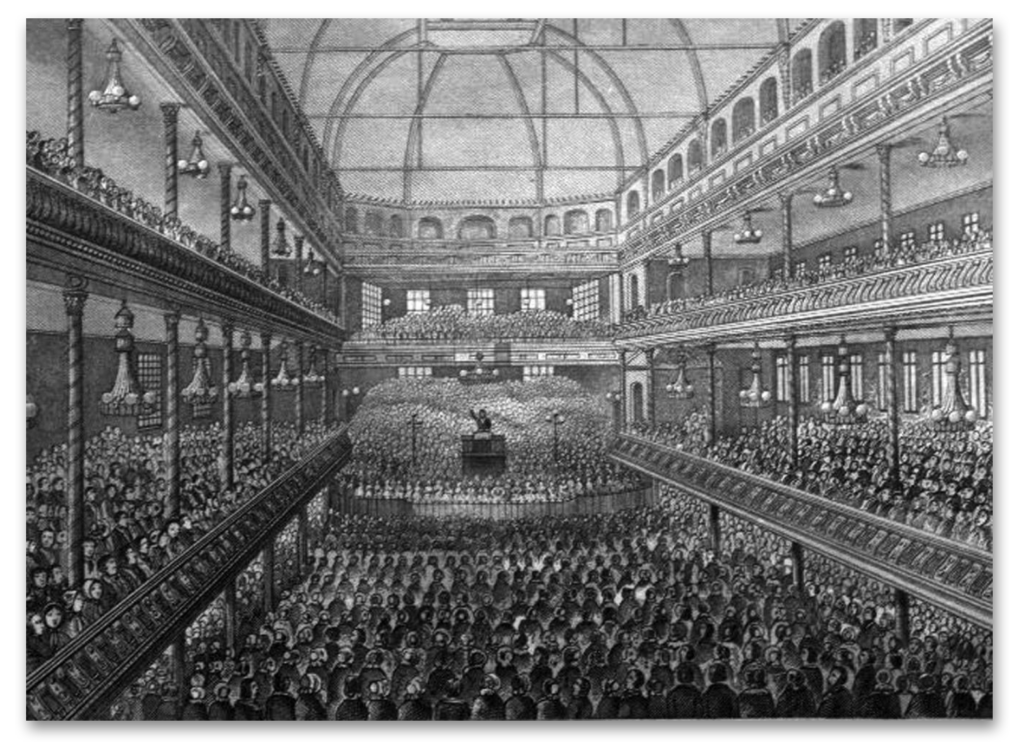
Charles Spurgeon’s reputation as a bold preacher is well-deserved. He preached openly about sin and held nothing back, and he always offered the hope of Christ. This included his approach to sexual sin.
Spurgeon regularly preached against the dangers and temptations of sexual immorality, and he did this with an openness that shocked the Victorian sensibilities of his contemporaries.
Bold and Direct
In a sermon on 1 Corinthians 6:9–11, where Paul warns that “No sexually immoral people… will inherit God’s kingdom,” Spurgeon brought the force of his text to bear on his congregation:
Not necessarily in the bonds of wedlock should we all be, but always in the bonds of purity; and those who sin against that which is pure, in their intercourse with one another, shall not inherit the kingdom of God. Nothing could be more explicit than this inspired declaration of the apostle. If any persons live in lust and uncleanness, God will not permit them to defile his true Church on earth, or to profane his temple above.[1]
In Spurgeon’s day, many would have found sexual immorality to be unacceptable and improper to speak about in the “temple” here below—the church gathered here on earth. But Spurgeon felt a pastoral urgency based upon the fact that unrepentant sexual sinners aren’t permitted in God’s “temple above.” Spurgeon knew that urgent warnings against any kind of sexual immorality were always necessary.
Spurgeon continued to address those who may have felt that the subject at hand was inappropriate for a minister of the gospel:
It is quite possible that I may be speaking to some people upon whose ears this message grates very harshly,—for all sorts of hearers come to this place,—and they will be the first to say, “The preacher should not mention such a subject.” My answer to that remark is: Then, you should not commit such iniquity, and give me cause to speak of it. As long as there are, in the world, sinners of this character, there must be servants of the Lord Jesus Christ faithful enough to pluck the velvet from their mouths, and to speak with the utmost plainness about them and to them.[2]
Did you catch that? Spurgeon’s response to people who told him to stop preaching about sexual sin was basically: “Stop giving me a reason to preach about it.”
As long as sexual sinners were believing the lies of the world, the flesh, and the devil, Spurgeon wasn’t going to hold back. The cost was too high.
What Can Pastors Learn from Spurgeon on Preaching in a Sexually Confused World?
1. Preach Boldly about Sin.
As watchmen on the wall, we must warn people about the dangers of sexual immorality.
Recent data shows that nearly a quarter of all practicing Christians view pornography at least once a week. More than half of practicing Christians view it regularly.[3] We are fooling ourselves and our people if we think our church is exempt from this catastrophe. People in your church have “given you cause to speak” about this issue. Will you speak up?
While pornography use is rampant in the church, talking about it is not. The vast majority (84%) of pornography users say that no one is helping them grow and fight this habitual sin; half say that no one knows that they regularly view pornography.[4] We must bring God’s truth—the truth that sets people free.
Speak up, pastor. People need it.
2. Preach Clearly about Righteousness.
As shepherds of the sheep, we must instruct our people to put on purity, not just put off sexual immorality. The world is not afraid to speak openly about sexual topics; we should not blush to joyfully and boldly proclaim God’s design for sex within marriage.
3. Preach Centrally about Christ.
Sexual sinners need more than behavior change.
Broken marriages need more than communication tips.
Those enslaved to pornography need more than internet filters.
People need Christ. Preach the forgiving, freeing, and transforming power of Christ crucified and raised for all kinds of sinners.
That’s where Paul goes in 1 Corinthians 6, “And some of you used to be like this. But you were washed, you were sanctified, you were justified in the name of the Lord Jesus Christ and by the Spirit of our God” (v. 11). Spurgeon explained:
The Lord seems to have said, “I will stretch out my hand, and I will save some of the very chief of sinners, in order that, throughout all time, it may be known that my gospel can effect the salvation of all sorts of sinners, even the most degraded. However depraved and fallen they may be, they cannot have gone beyond the reach of the gospel of my Son.” Is not that a glorious fact?
Oh! When I think of some of you big sinners, whom the Lord has saved under my ministry, I stand on this platform, and, with the utmost confidence, cry to the guiltiest sinners who may be present, “Come along with you, whoever you may be; I have a gospel that is just suited to you.” I can say, “Come, you who are moral and refined, who have never gone into any gross sin; here is a gospel just suitable for you;” but I am glad also to be able to add, “Come along, you who have raked the very kennels of hell with your iniquities, here is that which can wash you, and make you white as the newly-fallen snow.”[5]
A Resource to Help
My book, Sex and Self-Forgetfulness (2026, New Growth Press), is a 30-day journey for married couples to discover and live out God’s design for unifying sex. This book is a guide to help couples overcome common sexual struggles (including past and current sexual sin, one-sided sex, past sexual abuse, and more) by living out the love of Christ for one another. It’s available now wherever books are sold.
I hope it helps you talk about sexual purity and God’s gift of sex in a more open and constructive way to bless your own marriage and the marriages in your church.
——————
Doug Hanna (M.Div., The Southern Baptist Theological Seminary) is a pastor, creator of @SpurgeonBooks on Instagram (the account that 12 of your friends probably follow), and author of Sex and Self-Forgetfulness.
[1] Spurgeon, C. H. “A Marvellous Change.” In The Metropolitan Tabernacle Pulpit Sermons, 46:61–72. London: Passmore & Alabaster, 1900, page 62.
[2] Ibid.
[3] https://www.barna.com/trends/over-half-of-practicing-christians-admit-they-use-pornography/
[4] Ibid.
[5] “A Marvellous Change,” page 66.